
Why Does the Skin Around My Nose Feel Rough and Uneven?
Even when you cleanse your face thoroughly, you may notice that the skin around your nose still feels rough, bumpy, or uneven.
When you look closely in the mirror, you might see tiny dots and wonder,
“Do I really have that many blackheads?”
But not every visible dot or rough area around the nose is caused by blackheads.
The nose naturally tends to produce more oil than many other areas of the face, and the pores are often more noticeable. Because of this, blackheads, sebaceous filaments, dead skin buildup, and dryness can sometimes appear at the same time.
And this rough texture isn’t always limited to the nose.
Depending on your skin, you may also notice uneven texture around the sides of the nose, on the inner cheeks, around the cheekbones, or even across larger areas of the face.
So rather than assuming that every visible dot is a blackhead, it helps to first understand what you may actually be seeing on your skin.
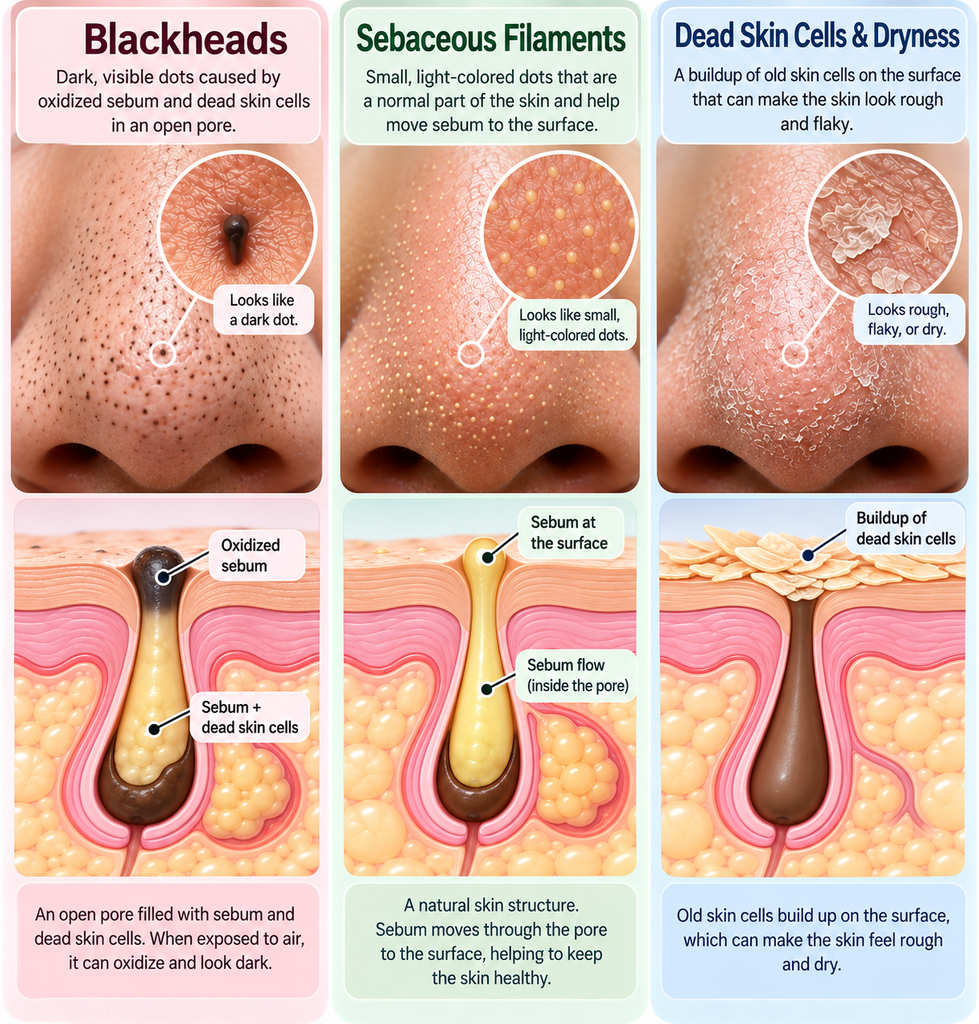
1. Blackheads
Blackheads are a type of open comedone that forms when sebum and dead skin cells build up inside a pore.
Because the pore remains open, the material at the surface is exposed to air and oxidizes, which can make it appear dark brown or black.
What can blackheads look like?
- Dark or black dots that are relatively easy to see
- Individual pores that look more noticeably clogged than the surrounding pores
- Small bumps or uneven texture that you may be able to feel
If you notice blackheads, repeatedly squeezing them with your fingers or nails is not recommended.
Too much pressure can irritate the skin and may lead to redness or skin damage.
2. Sebaceous Filaments
One of the things most commonly confused with blackheads is sebaceous filaments.
Unlike blackheads, sebaceous filaments are not acne lesions. They are normal structures within the follicle associated with the natural movement of sebum toward the skin’s surface.
They contain sebum and skin cells and are often more noticeable in areas where oil production is higher, especially on the tip and sides of the nose.
What can sebaceous filaments look like?
- Tiny gray, ivory, or pale yellow dots
- Small dots that appear relatively uniform across many pores
- More noticeable dots around the tip and sides of the nose
There is an important difference between sebaceous filaments and blackheads.
Sebaceous filaments do not need to be individually removed like blackheads.
Even after they are cleared or made less visible, the skin continues to produce sebum, so they may gradually become noticeable again.
Instead of repeatedly squeezing the pores in an attempt to completely remove them, it is more helpful to focus on keeping excess sebum and dead skin buildup under control while maintaining the overall condition of the skin.
3. Dead Skin Buildup & Dryness
Sometimes there may not be many dark dots at all, yet the skin feels flaky, rough, or almost sandpaper-like when you touch it.
In these cases, the texture may not be caused primarily by oil inside the pores. Dead skin buildup, flaking skin cells, and lack of moisture at the skin’s surface may also contribute to the rough feeling.
What can this look or feel like?
- Rough texture is more noticeable than dark dots
- Makeup may look patchy or cling unevenly around the nose or cheeks
- White or flaky skin may be visible on the surface
- The skin may feel tight after cleansing but become oily again later
If this type of texture is mistaken for blackheads, repeatedly squeezing the skin or using aggressive exfoliation may actually leave the skin feeling drier and more sensitive.
How Can You Tell the Difference?
Dark or black dots are clearly visible in individual pores
→ Possibly blackheads
Tiny gray, ivory, or pale yellow dots appear evenly across many pores
→ Possibly sebaceous filaments
The skin feels flaky or rough, with texture being more noticeable than dark dots
→ Dead skin buildup or dryness may be contributing
In real skin, however, it is very common to see more than one of these at the same time.
For example:
Sebaceous filaments + dead skin buildup + a few blackheads
may all be present in the same area.
That is why it is helpful to look at the overall condition of the skin rather than judging by color or appearance alone.
Does Everything You See in a Pore Need to Be Removed?
When you see something inside a pore, it can be tempting to squeeze it out and make the pore look completely clean.
But not everything you can see needs to be removed.
Blackheads are open comedones formed by a buildup of sebum and dead skin cells. Sebaceous filaments, on the other hand, are associated with the skin’s normal sebum flow and can naturally remain visible.
And rough texture does not always mean there is oil trapped inside the pores.
If dryness or lifted dead skin cells are contributing to the texture, repeated squeezing or aggressive exfoliation can make the skin feel even rougher and more sensitive.
When it comes to pore care, the goal should not simply be “How much can I remove?”
The more important question is “What does my skin actually need right now?”
Why Doesn’t One Treatment Last Forever?
Skin does not stay exactly the same after it has been cleansed or professionally cared for.
Your skin is constantly changing.
Sebum continues to be produced. New skin cells are continually formed, while older cells naturally shed from the surface.
Skin condition can also change with the seasons, dryness, sun exposure, lifestyle, and other environmental factors.
So even if visible sebum and dead skin buildup are thoroughly cleared today, that does not mean your skin will stop producing sebum.
Over time, pores can naturally fill with sebum again, and new skin cells will continue to form.
Sebaceous filaments, in particular, are part of the normal process associated with sebum movement through the follicle, so it is natural for them to become visible again after they have been cleared or made less noticeable.
This does not mean that your previous skincare treatment did not work.
It simply reflects the fact that your skin continues its natural cycle of producing sebum and renewing skin cells.
Pore Care Is More About Maintenance Than “Removing Everything”
Skincare is not about removing everything once and expecting the skin to stay that way permanently.
It is better thought of as clearing what is currently noticeable and maintaining healthy-looking skin as it continues to change over time.
Because sebum and skin cells are continuously produced, aggressively removing them once will not make them disappear permanently.
Instead of squeezing or stripping the skin every time pores become noticeable, it is better to care for what the skin needs at that moment while maintaining a balanced skin condition.
Some concerns can be managed as part of a regular skincare routine. When blackheads are difficult to manage on your own, or when excess sebum and dead skin buildup are making the skin feel particularly rough, professional skincare may also help address the areas that need more focused attention.
Ultimately, what matters is not how much you can remove at once, but how well you can maintain the skin without causing unnecessary irritation.
Remember
Blackheads ≠ Sebaceous Filaments ≠ Dead Skin Buildup
They are different, but more than one can appear on the same person’s skin at the same time.
If your nose feels rough and you notice tiny dots, there is no need to assume that everything you see is a blackhead.
Before squeezing or aggressively exfoliating, take a closer look at what you are actually seeing, whether the skin may be dry, and whether sebum and dead skin buildup may be present together.
Your skin will continue to produce sebum and go through its natural renewal cycle.
The goal of good skincare is not to remove everything all at once, but to care for what the skin needs and maintain a healthy, balanced condition over time.
Skin Care Jayna
If you experience persistent redness, pain, inflammation, severe itching, or signs of a possible skin condition, avoid repeated extraction or exfoliation and consult a dermatologist or qualified medical professional.