Blackheads, Sebaceous Filaments, or Dead Skin Buildup?

Why Does the Skin Around My Nose Feel Rough and Uneven?

Even when you cleanse your face thoroughly, you may notice that the skin around your nose still feels rough, bumpy, or uneven.

When you look closely in the mirror, you might see tiny dots and wonder,

“Do I really have that many blackheads?”

But not every visible dot or rough area around the nose is caused by blackheads.

The nose naturally tends to produce more oil than many other areas of the face, and the pores are often more noticeable. Because of this, blackheads, sebaceous filaments, dead skin buildup, and dryness can sometimes appear at the same time.

And this rough texture isn’t always limited to the nose.

Depending on your skin, you may also notice uneven texture around the sides of the nose, on the inner cheeks, around the cheekbones, or even across larger areas of the face.

So rather than assuming that every visible dot is a blackhead, it helps to first understand what you may actually be seeing on your skin.


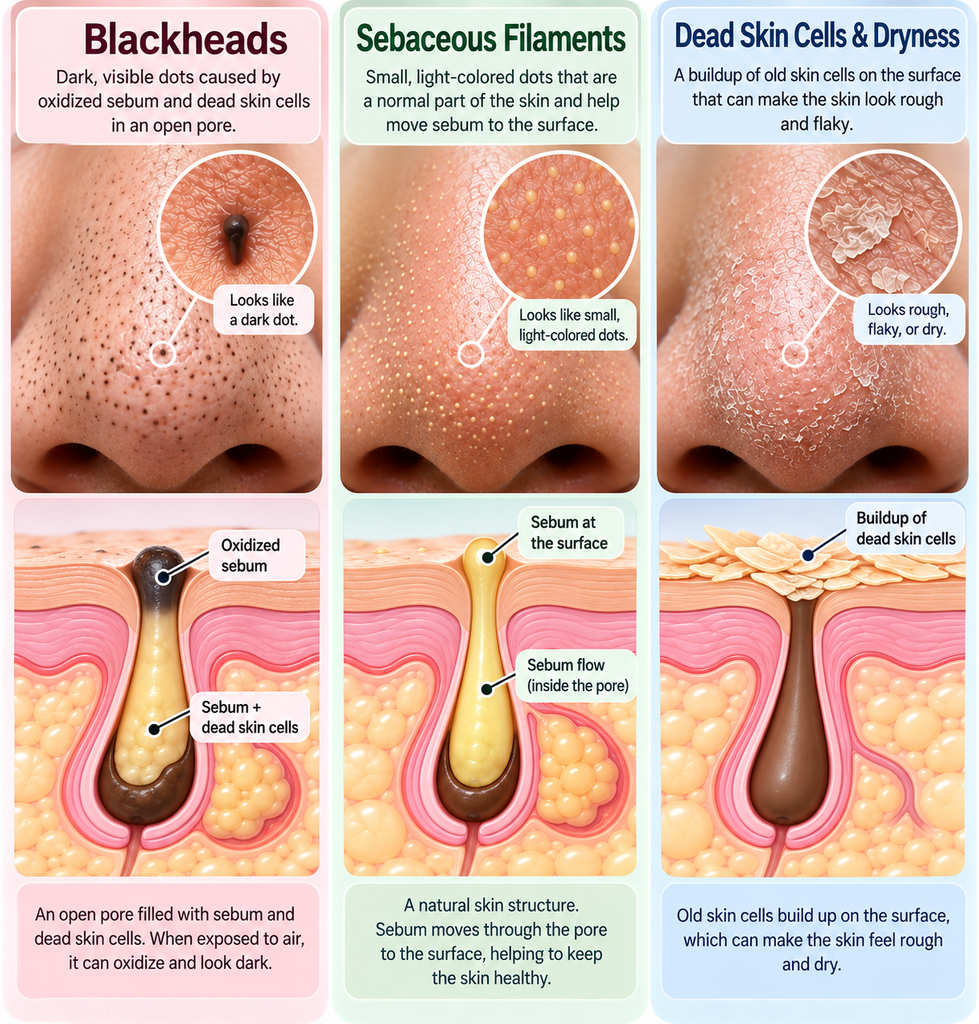
1. Blackheads

Blackheads are a type of open comedone that forms when sebum and dead skin cells build up inside a pore.

Because the pore remains open, the material at the surface is exposed to air and oxidizes, which can make it appear dark brown or black.

What can blackheads look like?

  • Dark or black dots that are relatively easy to see
  • Individual pores that look more noticeably clogged than the surrounding pores
  • Small bumps or uneven texture that you may be able to feel

If you notice blackheads, repeatedly squeezing them with your fingers or nails is not recommended.

Too much pressure can irritate the skin and may lead to redness or skin damage.


2. Sebaceous Filaments

One of the things most commonly confused with blackheads is sebaceous filaments.

Unlike blackheads, sebaceous filaments are not acne lesions. They are normal structures within the follicle associated with the natural movement of sebum toward the skin’s surface.

They contain sebum and skin cells and are often more noticeable in areas where oil production is higher, especially on the tip and sides of the nose.

What can sebaceous filaments look like?

  • Tiny gray, ivory, or pale yellow dots
  • Small dots that appear relatively uniform across many pores
  • More noticeable dots around the tip and sides of the nose

There is an important difference between sebaceous filaments and blackheads.

Sebaceous filaments do not need to be individually removed like blackheads.

Even after they are cleared or made less visible, the skin continues to produce sebum, so they may gradually become noticeable again.

Instead of repeatedly squeezing the pores in an attempt to completely remove them, it is more helpful to focus on keeping excess sebum and dead skin buildup under control while maintaining the overall condition of the skin.


3. Dead Skin Buildup & Dryness

Sometimes there may not be many dark dots at all, yet the skin feels flaky, rough, or almost sandpaper-like when you touch it.

In these cases, the texture may not be caused primarily by oil inside the pores. Dead skin buildup, flaking skin cells, and lack of moisture at the skin’s surface may also contribute to the rough feeling.

What can this look or feel like?

  • Rough texture is more noticeable than dark dots
  • Makeup may look patchy or cling unevenly around the nose or cheeks
  • White or flaky skin may be visible on the surface
  • The skin may feel tight after cleansing but become oily again later

If this type of texture is mistaken for blackheads, repeatedly squeezing the skin or using aggressive exfoliation may actually leave the skin feeling drier and more sensitive.


How Can You Tell the Difference?

Dark or black dots are clearly visible in individual pores
Possibly blackheads

Tiny gray, ivory, or pale yellow dots appear evenly across many pores
Possibly sebaceous filaments

The skin feels flaky or rough, with texture being more noticeable than dark dots
Dead skin buildup or dryness may be contributing

In real skin, however, it is very common to see more than one of these at the same time.

For example:

Sebaceous filaments + dead skin buildup + a few blackheads

may all be present in the same area.

That is why it is helpful to look at the overall condition of the skin rather than judging by color or appearance alone.

Does Everything You See in a Pore Need to Be Removed?

When you see something inside a pore, it can be tempting to squeeze it out and make the pore look completely clean.

But not everything you can see needs to be removed.

Blackheads are open comedones formed by a buildup of sebum and dead skin cells. Sebaceous filaments, on the other hand, are associated with the skin’s normal sebum flow and can naturally remain visible.

And rough texture does not always mean there is oil trapped inside the pores.

If dryness or lifted dead skin cells are contributing to the texture, repeated squeezing or aggressive exfoliation can make the skin feel even rougher and more sensitive.

When it comes to pore care, the goal should not simply be “How much can I remove?”

The more important question is “What does my skin actually need right now?”


Why Doesn’t One Treatment Last Forever?

Skin does not stay exactly the same after it has been cleansed or professionally cared for.

Your skin is constantly changing.

Sebum continues to be produced. New skin cells are continually formed, while older cells naturally shed from the surface.

Skin condition can also change with the seasons, dryness, sun exposure, lifestyle, and other environmental factors.

So even if visible sebum and dead skin buildup are thoroughly cleared today, that does not mean your skin will stop producing sebum.

Over time, pores can naturally fill with sebum again, and new skin cells will continue to form.

Sebaceous filaments, in particular, are part of the normal process associated with sebum movement through the follicle, so it is natural for them to become visible again after they have been cleared or made less noticeable.

This does not mean that your previous skincare treatment did not work.

It simply reflects the fact that your skin continues its natural cycle of producing sebum and renewing skin cells.


Pore Care Is More About Maintenance Than “Removing Everything”

Skincare is not about removing everything once and expecting the skin to stay that way permanently.

It is better thought of as clearing what is currently noticeable and maintaining healthy-looking skin as it continues to change over time.

Because sebum and skin cells are continuously produced, aggressively removing them once will not make them disappear permanently.

Instead of squeezing or stripping the skin every time pores become noticeable, it is better to care for what the skin needs at that moment while maintaining a balanced skin condition.

Some concerns can be managed as part of a regular skincare routine. When blackheads are difficult to manage on your own, or when excess sebum and dead skin buildup are making the skin feel particularly rough, professional skincare may also help address the areas that need more focused attention.

Ultimately, what matters is not how much you can remove at once, but how well you can maintain the skin without causing unnecessary irritation.


Remember

Blackheads ≠ Sebaceous Filaments ≠ Dead Skin Buildup

They are different, but more than one can appear on the same person’s skin at the same time.

If your nose feels rough and you notice tiny dots, there is no need to assume that everything you see is a blackhead.

Before squeezing or aggressively exfoliating, take a closer look at what you are actually seeing, whether the skin may be dry, and whether sebum and dead skin buildup may be present together.

Your skin will continue to produce sebum and go through its natural renewal cycle.

The goal of good skincare is not to remove everything all at once, but to care for what the skin needs and maintain a healthy, balanced condition over time.

Skin Care Jayna

If you experience persistent redness, pain, inflammation, severe itching, or signs of a possible skin condition, avoid repeated extraction or exfoliation and consult a dermatologist or qualified medical professional.
코 블랙헤드일까? 피지 필라멘트일까? 묵은 각질일까?

코와 모공이 왜 매끈하지 않을까?

세안은 꼼꼼하게 하는데도 유독 코가 까슬까슬하고 오돌토돌하게 느껴질 때가 있습니다.

거울을 가까이 들여다보면 작은 점들이 보여서
“블랙헤드가 이렇게 많은 건가?”라고 생각하기도 하지요.

하지만 코에 보이는 작은 점과 거친 촉감이 모두 블랙헤드 때문인 것은 아닙니다.

코는 얼굴의 다른 부위보다 피지 분비가 활발하고 모공이 눈에 잘 띄는 부위입니다. 그래서 블랙헤드, 피지 필라멘트(Sebaceous Filaments), 묵은 각질과 건조함이 함께 나타나기도 합니다.

또 이런 거친 촉감은 꼭 코에만 나타나는 것은 아닙니다. 사람에 따라 콧방울 옆, 코 옆 볼 안쪽, 광대 주변, 때로는 얼굴 전체적으로 피부가 거칠고 오돌토돌하게 느껴질 수도 있습니다.

따라서 무조건 “블랙헤드가 많다”고 생각하기보다는 지금 피부에서 무엇이 보이고 있는지 먼저 살펴보는 것이 중요합니다.


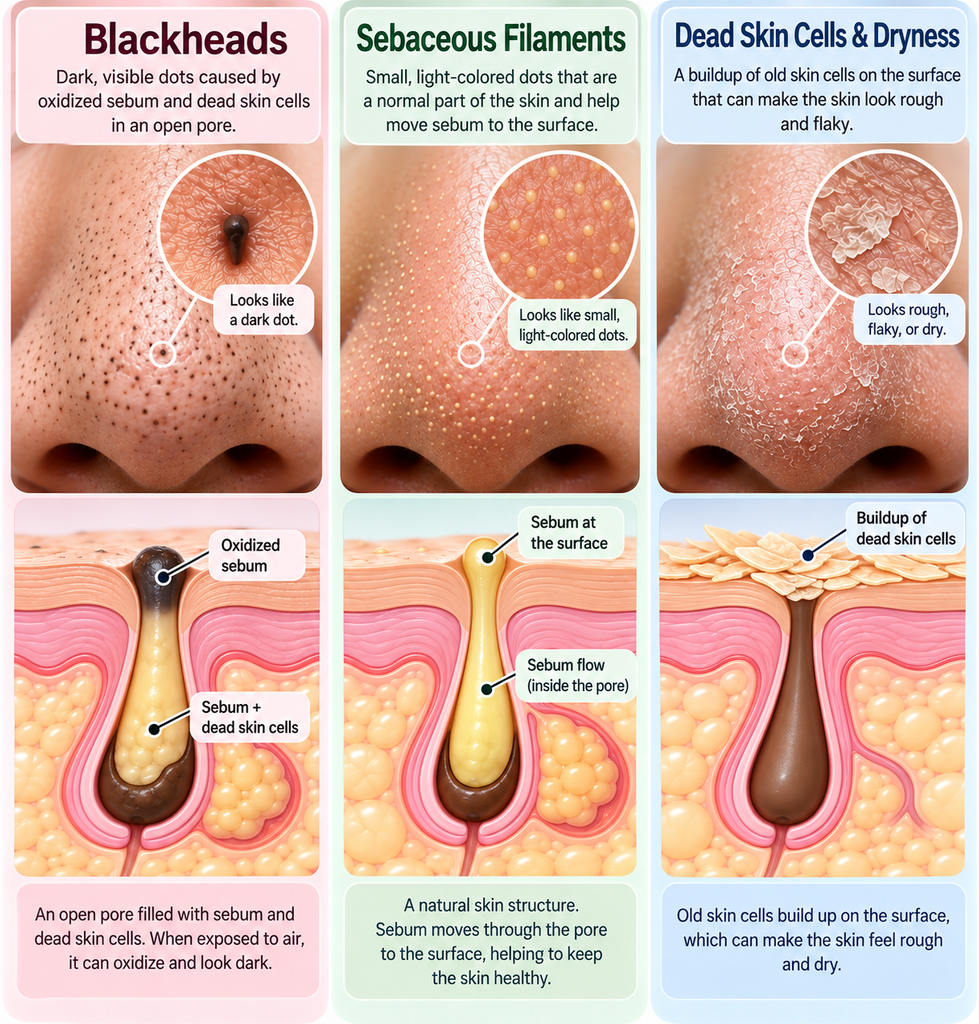
1. 블랙헤드 (Blackheads)

블랙헤드는 모공 안에 피지와 각질이 쌓여 형성되는 개방면포(Open Comedone) 입니다.

모공 입구가 열려 있어 피지와 각질이 공기에 노출되면 표면이 산화되면서 검거나 짙은 점처럼 보일 수 있습니다.

이런 모습으로 보일 수 있어요

  • 검거나 짙은 점이 비교적 뚜렷하게 보입니다.
  • 코 전체에 똑같이 퍼져 있기보다 특정 모공에 콕콕 박혀 보일 수 있습니다.
  • 일부는 만졌을 때 오돌토돌하게 느껴질 수 있습니다.

블랙헤드가 보인다고 해서 손이나 손톱으로 반복해서 짜는 것은 피하는 것이 좋습니다.

무리한 압출은 피부에 자극을 주고 붉어짐이나 피부 손상을 남길 수 있기 때문입니다.


2. 피지 필라멘트 (Sebaceous Filaments)

블랙헤드와 가장 많이 혼동되는 것이 피지 필라멘트입니다.

피지 필라멘트는 여드름 병변인 블랙헤드와 달리 모낭 안에서 피지가 피부 표면으로 이동하는 정상적인 과정과 관련된 구조입니다.

피지와 각질세포 등이 모낭 안에 가느다랗게 모여 있으며, 피지 분비가 활발한 코끝과 콧방울 주변에서 특히 눈에 잘 띌 수 있습니다.

이런 모습으로 보일 수 있어요

  • 회색, 아이보리 또는 연한 노란빛의 작은 점들이 보입니다.
  • 비슷한 크기의 점들이 여러 모공에 비교적 촘촘하고 균일하게 나타날 수 있습니다.
  • 코끝과 콧방울 주변에서 특히 눈에 띄는 경우가 많습니다.

여기서 블랙헤드와의 중요한 차이가 있습니다.

피지 필라멘트는 블랙헤드처럼 하나하나 모두 제거해야 하는 것이 아닙니다.

정돈한 후에도 피부에서는 계속 피지가 분비되기 때문에 시간이 지나면 다시 눈에 띌 수 있습니다.

따라서 피지 필라멘트를 없애기 위해 모공을 반복적으로 강하게 압출하기보다는 피지와 각질이 과도하게 쌓이지 않도록 피부 컨디션을 관리하는 것이 중요합니다.


3. 묵은 각질과 건조함 (Dead Skin Cells & Dryness)

거울로 봤을 때 검은 점은 많지 않은데 손으로 만져보면 부슬부슬하거나 사포처럼 까슬까슬하게 느껴지는 피부도 있습니다.

이런 경우에는 모공 속 피지만의 문제가 아니라 피부 표면에 쌓이거나 들뜬 각질과 수분 부족이 거친 촉감에 영향을 주고 있을 수 있습니다.

이런 모습으로 나타날 수 있어요

  • 검은 점보다 거친 촉감이 먼저 느껴집니다.
  • 코나 볼 주변에서 화장이 들뜨거나 뭉칠 수 있습니다.
  • 피부 표면에 하얗게 들뜬 각질이 보이기도 합니다.
  • 세안 후 피부는 당기는데 시간이 지나면서 다시 피지가 올라오기도 합니다.

이런 피부를 블랙헤드라고 생각해 계속 짜거나, 거친 촉감을 없애려고 강한 각질 제거를 반복하면 오히려 피부가 더 건조하고 예민해질 수 있습니다.


한눈에 구별해 볼까요?

검거나 짙은 점이 특정 모공에 비교적 뚜렷하게 보인다
→ 블랙헤드 가능성

작은 회색·아이보리·연한 노란빛의 점들이 여러 모공에 촘촘하고 비교적 균일하게 보인다
→ 피지 필라멘트 가능성

검은 점보다 만졌을 때 부슬부슬하고 까칠한 느낌이 더 크다
→ 묵은 각질이나 건조함의 영향 가능성

하지만 실제 피부에서는 한 가지만 나타나는 것보다

피지 필라멘트 + 묵은 각질 + 일부 블랙헤드

처럼 여러 가지가 함께 나타나는 경우도 흔합니다.

따라서 색이나 모양 하나만 보고 판단하기보다 전체적인 피부 상태를 함께 살펴보는 것이 중요합니다.


보이는 것을 모두 제거해야 할까요?

모공 속에 무언가 보이면 깨끗하게 전부 짜내고 싶어질 수 있습니다.

하지만 보이는 것이 모두 제거해야 할 대상은 아닙니다.

블랙헤드처럼 모공 안에 피지와 각질이 쌓여 형성된 면포가 있는 반면, 피지 필라멘트처럼 정상적인 피지 분비 과정과 관련되어 자연스럽게 보이는 구조도 있습니다.

또 피부가 까슬하게 느껴진다고 해서 항상 모공 속 피지가 원인인 것도 아닙니다.

건조함이나 들뜬 각질이 원인이라면 반복적인 압출이나 과도한 각질 제거가 오히려 피부를 더 거칠고 예민하게 만들 수 있습니다.

그래서 모공 관리에서 중요한 것은 얼마나 많이 제거했느냐가 아니라 현재 피부에서 무엇이 필요한지를 구분하는 것입니다.


왜 한 번 관리한다고 끝나지 않을까요?

피부는 한 번 깨끗하게 정돈했다고 해서 그 상태로 계속 머물러 있지 않습니다.

피부는 매일 변화하고 있기 때문입니다.

피부에서는 계속 피지가 분비되고 새로운 각질이 만들어지며, 오래된 각질은 자연스럽게 떨어져 나가는 과정이 반복됩니다.

계절과 건조함, 자외선, 생활 습관 등 여러 환경에 따라서도 피부 컨디션은 달라질 수 있습니다.

따라서 오늘 눈에 띄던 피지와 각질을 깨끗하게 정돈했다고 해도 피지 자체가 더 이상 만들어지지 않는 것은 아닙니다.

시간이 지나면 모공에는 다시 피지가 차오를 수 있고 새로운 각질도 만들어집니다.

특히 피지 필라멘트는 정상적인 피지 분비 과정과 관련된 구조이기 때문에 정돈한 후 다시 눈에 보이는 것은 자연스러운 현상입니다.

이것은 이전의 관리가 소용없었다는 의미가 아닙니다.

피부가 계속 피지를 분비하고 각질이 교체되는 자연스러운 과정을 이어가고 있기 때문에 나타나는 변화입니다.


모공 관리도 ‘제거’보다 ‘유지’가 중요합니다

피부관리는 한 번의 관리로 모든 것을 없애는 과정이라기보다 현재 도드라진 부분을 정돈하고, 피부가 다시 변화하는 과정에 맞춰 좋은 컨디션을 유지해 나가는 과정에 가깝습니다.

피지와 각질은 피부에서 계속 만들어지기 때문에 한 번 강하게 제거한다고 해서 영구적으로 사라지는 것은 아닙니다.

따라서 모공이 신경 쓰일 때마다 반복적으로 짜거나 벗겨내기보다는 현재 피부 상태에 맞게 필요한 부분을 정돈하고 좋은 컨디션을 유지하는 관리가 중요합니다.

일상적으로 관리할 수 있는 부분도 있지만, 혼자 정리하기 어려운 블랙헤드가 있거나 피지와 각질이 많이 쌓여 피부가 거칠어진 경우에는 피부 상태를 확인한 후 전문적인 스킨케어를 통해 필요한 부분을 집중적으로 관리할 수도 있습니다.

결국 중요한 것은 한 번에 얼마나 많이 제거했느냐보다 피부에 불필요한 자극을 주지 않으면서 좋은 상태를 얼마나 안정적으로 유지하느냐입니다.


기억하세요

블랙헤드 ≠ 피지 필라멘트 ≠ 묵은 각질

서로 다른 상태이지만 한 사람의 피부에 동시에 나타날 수도 있습니다.

코가 거칠고 작은 점들이 보인다고 해서 모두 블랙헤드라고 생각할 필요는 없습니다.

무조건 짜고 벗겨내기 전에 지금 보이는 것이 무엇인지, 피부가 건조한 것은 아닌지, 피지와 각질이 함께 쌓여 있는 것은 아닌지 먼저 살펴보는 것이 중요합니다.

그리고 피부는 계속 피지를 만들고 새로운 각질 주기를 반복합니다.

좋은 스킨케어의 목표는 모든 것을 한 번에 없애는 것이 아니라, 그때그때 필요한 부분을 정돈하면서 좋은 피부 컨디션을 꾸준히 유지하는 것입니다.

Skin Care Jayna

※ 피부에 지속적인 붉어짐, 통증, 염증, 심한 가려움이 있거나 피부질환이 의심되는 경우에는 반복적으로 압출하거나 각질을 제거하기보다 피부과 전문의와 상담하시기 바랍니다.


Not Acne, But Tiny Bumps on Your Face? Causes of Clogged Pores and Sebum


When your skin feels rough to the touch, it doesn’t always mean that dead skin cells are simply sitting on the surface.

Sometimes, even when there is no visible flaking, you may feel tiny bumps or grain-like texture underneath the surface when you gently run your fingers over your skin.

This can be especially noticeable on areas such as the forehead, inner cheeks, chin, and jawline, where oil and dead skin cells can accumulate more easily inside the pores.

When sebum and dead skin cells do not shed or move out of the pores efficiently, they can build up and create small clogged pores or closed comedones (whiteheads), giving the skin a bumpy, uneven texture.

Some may appear as visible white bumps, while others are barely noticeable in the mirror. You may only realize they are there when you touch your skin and feel many tiny bumps beneath the surface.

Surface Dead Skin and Clogged Pores Can Feel Different

Surface dead skin
→ The skin may feel flaky, dry, rough, or slightly gritty when you run your fingers over it.

Oil and dead skin buildup inside the pores
→ You may feel multiple tiny, firm bumps underneath the surface, similar to very small grains.

It is also possible to have both conditions at the same time.

Some Bumpy Skin May Be Difficult to Manage With Home Care Alone

Light surface buildup, excess oil, and mild flaking can often be managed with gentle cleansing, proper hydration, and appropriate exfoliation at home.

However, when many small clogged pores have developed beneath the surface and the forehead, cheeks, chin, or jawline feels noticeably bumpy, home care alone may not be enough to fully improve the texture.

Trying to squeeze each bump at home or repeatedly using strong scrubs and peels is not recommended. Too much irritation can leave the skin feeling even drier, more sensitive, or red.

In these cases, professional skincare can help assess what is contributing to the uneven texture. Depending on the condition of the skin, clogged pores and excess buildup can be addressed gradually, followed by appropriate exfoliation and texture-focused care.

If the skin has not received professional care for a long time and there is significant buildup or congestion, it is usually better to work gradually over several sessions rather than trying to clear everything at once.

Once the pore congestion has improved, but the skin still feels rough or uneven, professional exfoliation or other texture-focused treatments may also be considered depending on the skin’s condition and individual needs.

A Simple Way to Think About It

Mild surface flakes and oily buildup
→ Consistent, gentle home care may be enough.

Multiple tiny bumps or clogged pores beneath the skin
→ Professional pore care may be helpful when home care is not enough.

Rough or uneven texture that remains after congestion is addressed
→ Additional texture-focused skincare may be beneficial.

The important thing is not to exfoliate more aggressively simply because the skin feels bumpy.

First, consider whether the roughness is coming from surface dead skin, buildup inside the pores, or a combination of both. Then choose a gradual approach that is appropriate for your skin’s current condition.

Skin conditions and responses vary from person to person. This information is for general skincare education. If you’re unsure whether your rough or bumpy skin is caused by surface buildup, clogged pores, or uneven skin texture, a professional skincare consultation can help you better understand your skin and choose the appropriate care.

여드름은 아닌데 얼굴이 오돌토돌해요|피부 속 좁쌀·피지 원인

각질이 아니라 피부 속에서 오돌토돌하게 만져질 수도 있어요

피부를 만졌을 때 느껴지는 거친 촉감이 항상 피부 표면의 묵은 각질 때문인 것은 아닙니다.

겉으로 각질이 일어나 있지 않은데도 손끝으로 피부를 쓸어보면 작은 알갱이나 좁쌀 같은 요철이 피부 안쪽에서 여러 개 만져지는 경우가 있습니다.

특히 이마, 볼 안쪽, 턱과 턱선처럼 피지와 각질이 모공 안에 쌓이기 쉬운 부위에서 이러한 느낌이 나타날 수 있습니다.

피지와 각질이 모공 밖으로 원활하게 배출되지 못하고 쌓이면 작은 면포성 막힘이나 화이트헤드처럼 오돌토돌한 피부결로 느껴질 수 있습니다.

겉으로 하얗게 올라와 눈에 보이는 것도 있지만, 눈으로는 크게 티가 나지 않으면서 손끝으로 만졌을 때 피부 안에 작은 알갱이가 여러 개 들어 있는 것처럼 느껴지는 경우도 있습니다.

표면의 각질과 피부 속 막힘은 느낌이 조금 다릅니다

표면의 묵은 각질
→ 피부를 쓸었을 때 부슬부슬하거나 까칠하고 거친 느낌

피지와 각질이 모공 안에 쌓인 경우
→ 피부 안쪽에서 좁쌀처럼 작은 요철이 톡톡 만져지는 느낌

물론 두 가지가 동시에 나타나는 피부도 있습니다.

이런 피부는 홈케어만으로 해결하기 어려울 수도 있습니다

피부 표면에 가볍게 쌓인 피지나 유분성 노폐물, 들뜬 각질은 부드러운 클렌징과 보습, 적절한 각질관리 등의 홈케어로 어느 정도 관리할 수 있습니다.

하지만 피부 안쪽에 작은 막힘이 여러 개 자리 잡아 이마·볼·턱선까지 오돌토돌한 요철이 많이 느껴지는 경우에는 홈케어만으로 모두 정돈하기 어려울 수 있습니다.

이때 피부가 거칠다고 해서 집에서 손으로 하나씩 짜거나 강한 스크럽과 필링을 반복하는 것은 좋은 방법이 아닙니다. 피부 표면만 계속 자극하면 오히려 붉음이나 건조함이 생길 수 있습니다.

이런 피부는 전문적인 스킨케어를 통해 현재 피부 상태를 먼저 살펴보고, 필요한 부분의 모공 막힘과 피지를 단계적으로 정돈하면서 피부 상태에 맞는 각질 및 피부결 관리를 병행하는 방법을 고려할 수 있습니다.

특히 오랫동안 피부관리를 쉬었거나 작은 막힘과 요철이 많이 쌓여 있다면 한 번에 모두 제거하려 하기보다 피부 반응을 살피면서 여러 차례에 나누어 정돈하는 것이 중요합니다.

모공 속 막힘이 어느 정도 정돈된 후에도 전체적으로 거칠고 고르지 않은 피부결이 남아 있다면, 피부 상태와 목적에 따라 전문적인 필링이나 피부결 개선을 위한 집중관리를 병행할 수도 있습니다.

쉽게 구분하면

가볍게 들뜬 각질·유분성 노폐물
→ 부드러운 홈케어로 꾸준히 관리

피부 속에 좁쌀처럼 여러 개 만져지는 작은 막힘
→ 홈케어만으로 어려운 경우 전문적인 모공 정돈 고려

막힘을 정돈한 후에도 남아 있는 거친 피부결과 요철
→ 피부 상태에 맞는 집중적인 피부결 관리

중요한 것은 오돌토돌하다고 무조건 더 강하게 벗겨내는 것이 아닙니다.

먼저 피부 표면의 각질인지, 모공 안에 쌓인 피지와 각질의 막힘인지, 또는 두 가지가 함께 나타나는 상태인지 살펴보고 현재 피부에 맞는 방법으로 단계적으로 관리하는 것이 좋습니다.

Recurring Acne Around the Chin and Mouth — Could It Be Folliculitis?

In my previous post, I discussed why adult acne can repeatedly appear around the chin and jawline.

However, after working with acne-prone skin for many years, I have also noticed cases that seem a little different.

Sometimes, as the overall condition of the skin improves, acne on the forehead and cheeks gradually becomes calmer, yet red bumps around the chin and mouth are much slower to improve—or they seem to clear, only to return in the same areas again.

I have seen this pattern many times while caring for acne-prone skin.

For that reason, when similar inflammation repeatedly appears around the chin and mouth, I don’t always assume that it is simply “acne coming back.”

That is because acne-like bumps can sometimes involve inflammation around the hair follicle, known as folliculitis.

It Looks Like Acne, But Could It Be Something Different?

Folliculitis is inflammation that develops around a hair follicle.

Because it can appear as small red bumps or pustules, it may look very similar to inflammatory acne.

In my skincare practice, I pay particular attention to the area beneath the lower lip, around the mouth, along the chin, and around the jawline.

In some clients, red and inflamed bumps repeatedly appear in these areas, while the surrounding skin may also look irritated, red, or uneven. In more noticeable cases, similar bumps may extend along the jawline toward the upper neck.

Of course, this does not mean that every breakout on the chin is folliculitis.

However, when similar bumps repeatedly appear in the same area and respond unusually slowly to regular acne care, I believe it is worth looking beyond acne alone and considering whether inflammation involving the hair follicles could also be present.

What If the Rest of the Acne Improves, but the Chin and Mouth Keep Breaking Out?

This is one of the main reasons I became interested in this particular pattern.

I have worked with clients who initially had acne throughout the face. With consistent care, the inflammation on the forehead and cheeks decreased, skin texture improved, and new breakouts became less frequent.

But sometimes the chin and mouth area behaved differently.

The area would improve, then suddenly become red and inflamed again. It would calm down, only for similar bumps to return in the same spot or nearby.

After seeing this pattern repeatedly, I began asking myself an important question:

“Should every red bump be treated as the same type of acne?”

Skin conditions can look similar on the surface while developing for very different reasons.

The chin and jawline, in particular, can be affected by several factors.

For women, hormonal changes may contribute to recurring acne around the chin and lower face. For men, repeated shaving can cause friction and irritation, while ingrown hairs or inflammation around the follicles may sometimes resemble acne.

Of course, this does not mean that every chin breakout in women is hormonal or that every breakout in men is caused by shaving. The point is that similar-looking breakouts may have different contributing factors from person to person.

Excess oil and dead skin buildup, repeated friction, sweat and humidity, irritation, and a weakened skin barrier may also play a role.

That is why it is important not to judge a breakout by its location alone. Instead, I look at how the bumps appear, how often they return, the condition of the surrounding skin, and how the skin responds to previous care.

Extractions Can Sometimes Reveal Different Characteristics

After many years of performing extractions and caring for acne-prone skin, I have noticed another interesting difference.

With typical comedonal acne, an extraction may release a more distinct plug of sebum and dead skin from the clogged pore. Once that material is removed, the congestion in that particular pore may appear more clearly relieved.

Some inflamed bumps involving the follicular area can look somewhat different.

Instead of a distinct plug, there may be pus or a small amount of blood, and sometimes the area may still feel firm underneath even after drainage.

I consider this one of many observational clues I may notice during skincare.

However, the appearance during an extraction alone cannot determine whether a bump is acne or folliculitis. Deep inflammatory acne can also produce pus, bleeding, and firmness beneath the skin.

For this reason, I don’t rely on extraction findings alone. I also consider where the inflammation occurs, how frequently it returns, what it looks like, the condition of the surrounding skin, and how it changes after care.

Acne and Folliculitis May Require Different Approaches

Although acne and folliculitis can look similar, they may develop through different processes and have different causes. Therefore, the appropriate approach may also differ.

Acne commonly involves clogged pores, excess sebum, dead skin cells, and inflammation. Folliculitis, on the other hand, may be associated with different factors, including bacteria, yeast, shaving, friction, or other forms of irritation affecting the hair follicles.

Because of this, treating every similar-looking bump with repeated extractions or strong exfoliation may not always be appropriate.

I don’t use exactly the same approach for every acne-prone client.

Even when breakouts look similar, I consider where they repeatedly occur, the type of inflammation present, skin sensitivity, the condition of the surrounding skin, and how the skin responds after each treatment. Based on these observations, I adjust the techniques and intensity of the skincare treatment.

When folliculitis may be a possibility, I believe it is especially important to avoid automatically treating every bump like a clogged comedone. The skin should be observed carefully, with an emphasis on minimizing unnecessary irritation.

Dermatology Treatment and Skincare Have Different Roles

Recurring acne or inflammation around the hair follicles can have different causes and may require different approaches.

When symptoms are severe, persistent, or repeatedly return, it is important to consult a dermatologist for an accurate diagnosis and appropriate medical treatment.

Esthetic skincare does not replace medical treatment. Instead, its role is to support the condition of the skin by addressing factors such as surface oil and dead skin buildup, redness and sensitivity, hydration, and the overall condition of the skin barrier, while avoiding unnecessary irritation.

When appropriate, professional skincare may also be used alongside medical care, depending on the individual’s skin condition. The important point is to understand the different roles of medical treatment and esthetic skincare and choose an approach that is appropriate for the current condition of the skin.

If it is difficult to determine whether recurring bumps are acne or folliculitis—or if the same type of inflammation continues despite regular acne care—it may be better to seek a dermatologist’s evaluation rather than repeatedly using strong treatments or extractions.

What Should You Consider When Breakouts Keep Returning Around the Chin and Mouth?

The chin and mouth area can be affected by many everyday factors, including shaving, friction, frequently touching the face, sweat and humidity, cleansing habits, and irritation from skincare or cosmetic products.

When the skin is already red and sensitive, repeated extractions or overly aggressive treatments may cause even more irritation.

Instead of focusing only on removing each visible breakout, it is important to consider whether the area is being repeatedly irritated, whether the surrounding skin is calm and balanced, and how the skin responds after each treatment.

Areas that need attention can be treated carefully, while calming the skin and supporting its overall condition should remain an important part of the process.

Final Thoughts

I don’t assume that every breakout on the chin is folliculitis.

However, after many years of caring for acne-prone skin, I have repeatedly noticed that when acne on other areas of the face improves but similar bumps continue to return around the chin and mouth, it may be worth looking at the situation from a slightly different perspective.

If you repeatedly extract the same areas only to see the bumps return again, instead of simply asking,

“Why does my acne keep coming back?”

it may also be worth asking,

“Could the bumps I’ve been treating as acne possibly be a different type of inflammation?”

Not every recurring breakout around the chin and mouth is folliculitis. But recognizing that similar-looking breakouts can behave differently—and choosing skincare based on the current condition of the skin—can make an important difference in how we approach ongoing skin concerns.


Disclaimer: This article is not intended to diagnose or treat any medical condition. It is based on general skincare information and observations from many years of working with acne-prone skin in a professional skincare setting. Recurring bumps around the chin and mouth do not necessarily indicate folliculitis, and an accurate diagnosis may require evaluation by a qualified medical professional. If inflammation is severe or persistent, or if you experience significant itching, pain, drainage, rapidly spreading redness, or worsening symptoms, please consult a dermatologist or other qualified healthcare professional.

계속 반복되는 턱·입 주변 여드름, 혹시 모낭염일까요?

지난 글에서는 성인 턱 여드름이 왜 턱과 턱선에 반복될 수 있는지 살펴보았습니다.

그런데 오랫동안 여드름 피부를 관리하다 보면 조금 다른 경우도 만나게 됩니다.

얼굴 전체의 여드름을 관리하면서 이마와 볼 등 다른 부위는 점차 좋아지는데, 유독 턱과 입 주변의 붉은 트러블만 호전이 느리거나 좋아진 듯하다가 같은 부위에 다시 올라오는 경우입니다.

저 역시 오랫동안 많은 여드름 피부를 관리하면서 이러한 경우를 자주 경험했습니다.

그래서 턱과 입 주변에서 같은 형태의 염증이 반복될 때는 단순히 ‘여드름이 또 생겼다’ 고만 생각하지 않습니다.

여드름과 비슷하게 보이는 모낭 주변의 염증, 즉 모낭염의 가능성도 함께 살펴볼 필요가 있기 때문입니다.

여드름처럼 보이지만 조금 다른 턱 주변의 트러블

모낭염은 말 그대로 털이 자라는 모낭에 염증이 생긴 상태를 말합니다.

붉은 돌기나 작은 농포의 형태로 나타날 수 있기 때문에 겉으로 보기에는 염증성 여드름과 상당히 비슷해 보일 수 있습니다.

특히 제가 관리 현장에서 눈여겨보는 곳은 아랫입술 아래의 턱, 입 주변, 턱라인입니다.

이 부위에 붉은 염증이 반복적으로 나타나거나 주변 피부까지 붉고 고르지 않게 보이는 경우가 있고, 심한 경우에는 턱라인을 따라 목 가까이까지 비슷한 형태의 트러블이 이어지기도 합니다.

물론 턱에 생긴 트러블이 모두 모낭염이라는 뜻은 아닙니다.

다만 같은 부위에서 반복되고 일반적인 여드름 관리에 대한 반응이 유난히 느리다면, 저는 여드름만 생각하기보다는 모낭을 중심으로 반복되는 염증의 가능성도 함께 관찰합니다.

다른 여드름은 좋아지는데 턱·입 주변만 반복된다면?

제가 많은 여드름 피부를 관리하면서 이 부분에 특히 관심을 갖게 된 이유도 바로 이것이었습니다.

얼굴 전체에 여드름이 있던 분이 꾸준히 관리를 받으면서 이마와 볼의 염증은 눈에 띄게 줄어들고, 피부결도 좋아지면서 새로운 여드름이 올라오는 횟수도 줄어드는 경우가 있습니다.

그런데 유독 입 주변과 턱은 다른 양상을 보이는 경우가 있었습니다.

분명 좋아졌는데 어느 순간 다시 붉게 올라오고, 진정되었다가 또 같은 자리 또는 가까운 곳에서 반복되는 것입니다.

이러한 경험이 반복되면서 저는 한 가지 생각을 하게 되었습니다.

‘모든 붉은 트러블을 같은 여드름으로 보고 똑같이 관리하는 것이 맞을까?’

피부 트러블은 겉모습이 비슷하더라도 원인과 피부 상태가 서로 다를 수 있습니다.

특히 턱과 턱선은 여러 요인이 겹쳐 나타날 수 있는 부위입니다.

여성의 경우에는 호르몬 변화와 관련해 턱과 아래 얼굴에 여드름이 반복되는 경우가 있고, 남성의 경우에는 반복적인 면도로 인한 마찰과 자극, 인그로운 헤어 또는 모낭 주변의 염증이 여드름과 비슷하게 보이기도 합니다.

물론 여성의 턱 트러블은 모두 호르몬 때문이고 남성은 모두 면도 때문이라는 의미는 아닙니다. 같은 턱 트러블처럼 보여도 사람마다 발생 배경이 다를 수 있다는 것입니다.

여기에 피지와 각질의 정체, 반복적인 마찰, 땀과 습한 환경, 피부 장벽의 약화와 자극 등 여러 요인이 함께 영향을 줄 수도 있습니다.

따라서 중요한 것은 위치 하나만으로 판단하는 것이 아니라 어떤 형태로 나타나는지, 얼마나 자주 반복되는지, 주변 피부가 어떤 상태인지, 기존 관리에 어떻게 반응하는지를 함께 살펴보는 것입니다.

압출 과정에서도 서로 다른 모습을 볼 수 있습니다

오랫동안 압출과 여드름 관리를 하면서 제가 관찰해온 차이 중 하나가 있습니다.

일반적인 면포성 여드름은 압출했을 때 모공 안에 있던 피지와 각질 덩어리가 쌀알처럼 비교적 분명하게 배출되는 경우가 많습니다. 피지와 각질이 배출된 후에는 해당 부위의 막힘이 어느 정도 정리된 것을 관찰할 수 있습니다.

반면 모낭 주변의 염증이 의심되는 일부 트러블은 조금 다른 양상을 보이기도 합니다.

뚜렷한 피지 덩어리보다는 농이나 혈액이 함께 보이기도 하고, 배출 후에도 해당 부위 안쪽에 단단함이 남아 있는 것처럼 느껴지는 경우가 있습니다.

저는 이러한 차이를 하나의 현장 관찰 포인트로 보고 있습니다.

하지만 압출했을 때 나타나는 모습 하나만으로 여드름과 모낭염을 구분하거나 진단할 수 있는 것은 아닙니다. 깊은 염증성 여드름에서도 농이나 출혈, 단단함이 나타날 수 있기 때문입니다.

그래서 압출 결과만 보는 것이 아니라 발생 위치와 반복 패턴, 염증의 형태, 주변의 붉은기와 피부 상태, 관리 후의 변화를 함께 관찰하는 것이 중요합니다.

여드름과 모낭염은 관리 방향도 다를 수 있습니다

여드름과 모낭염은 겉으로 비슷하게 보여도 발생하는 과정과 원인이 다를 수 있기 때문에 관리 방향 역시 같지 않을 수 있습니다.

일반적인 여드름은 피지와 각질에 의한 모공의 막힘과 염증을 중심으로 살펴보지만, 모낭염은 세균이나 효모, 면도와 마찰 같은 물리적인 자극 등 여러 원인에 의해 모낭을 중심으로 염증이 나타날 수 있습니다.

따라서 비슷하게 보이는 트러블이라고 해서 무조건 같은 방법으로 압출하거나 강한 각질 관리를 반복하는 것이 항상 적절한 것은 아닙니다.

저 역시 여드름 피부라고 해서 항상 같은 방식으로 관리하지 않습니다.

비슷하게 보이는 트러블이라도 반복되는 위치와 염증의 형태, 피부의 민감도, 주변 피부 상태와 관리 후 반응을 살펴보면서 관리 방법이나 강도, 테크닉을 조절합니다.

특히 모낭염이 의심되는 피부라면 일반적인 면포성 여드름처럼 무조건 압출하기보다 피부 상태를 세심하게 살펴보고, 과도한 자극을 줄이는 방향으로 접근하는 것이 중요하다고 생각합니다.

피부과 치료와 스킨케어의 역할은 다를 수 있습니다

반복되는 여드름이나 모낭 주변의 염증은 피부 상태와 원인에 따라 접근 방법이 달라질 수 있습니다.

증상이 심하거나 계속 반복되는 경우에는 피부과에서 정확한 진단을 받고 필요한 의학적 치료를 받는 것이 중요합니다.

에스테틱 스킨케어는 이러한 의료적 치료를 대신하는 것이 아니라 피부 표면의 피지와 각질 상태, 붉은기와 민감도, 피부 장벽과 수분 상태 등을 살펴보면서 피부가 과도한 자극을 받지 않고 보다 안정적인 컨디션을 유지하도록 관리하는 역할을 합니다.

필요한 경우 피부과에서 의학적인 치료를 받으면서 피부 상태에 맞는 스킨케어를 병행할 수도 있습니다. 중요한 것은 각각의 역할을 구분하고 현재 피부 상태에 맞는 방법을 선택하는 것입니다.

특히 여드름인지 모낭염인지 구분하기 어렵거나 일반적인 여드름 관리를 계속해도 같은 형태의 염증이 반복된다면, 무리하게 압출이나 강한 관리를 반복하기보다 피부과 진료를 통해 정확한 원인을 확인하는 것이 좋습니다.

반복되는 턱·입 주변 트러블, 관리할 때 중요한 점

턱과 입 주변은 면도나 마찰, 손으로 만지는 습관, 땀과 습기, 세안이나 화장품으로 인한 자극 등 다양한 영향을 받을 수 있는 부위입니다.

이미 붉고 민감해진 상태에서 반복적인 압출이나 강한 관리를 계속하면 피부가 더욱 예민해질 수 있습니다.

따라서 눈에 보이는 트러블만 계속 제거하기보다 피부가 반복적으로 자극받고 있지는 않은지, 주변 피부는 안정적인지, 관리 후에는 어떤 변화를 보이는지를 함께 살펴보는 것이 중요합니다.

필요한 부분은 조심스럽게 관리하되 피부가 지나치게 자극받지 않도록 진정과 피부 컨디션을 함께 살펴보는 것이 좋습니다.

마무리하며

저는 턱에 트러블이 생겼다고 해서 그것을 모두 모낭염이라고 생각하지 않습니다.

하지만 오랫동안 많은 여드름 피부를 관리하면서 다른 부위의 여드름은 좋아지는데 턱과 입 주변만 유독 반복되는 경우에는 조금 다른 시각으로 살펴볼 필요가 있다는 것을 여러 번 경험했습니다.

계속 짜고 또 올라오는 것을 반복하고 있다면 단순히

‘여드름이 왜 또 생겼지?’

라고만 생각하기보다,

‘혹시 내가 계속 여드름이라고 생각했던 이 트러블이 다른 형태의 염증은 아닐까?’

한번 살펴볼 필요가 있습니다.

턱과 입 주변에 반복되는 모든 트러블이 모낭염이라는 뜻은 아닙니다. 하지만 그 차이를 살펴보고 현재 피부 상태에 맞는 관리 방향을 찾는 것부터 피부관리는 달라질 수 있습니다.


※ 이 글은 피부질환을 진단하거나 치료하기 위한 의료정보가 아니라, 오랜 기간 스킨케어 현장에서 다양한 여드름 피부를 관리하며 관찰한 경험과 일반적인 피부관리 정보를 바탕으로 작성되었습니다. 턱과 입 주변의 반복되는 트러블이 모두 모낭염을 의미하는 것은 아니며, 정확한 구분에는 의료진의 진단이 필요할 수 있습니다. 반복되는 염증이 심하거나 가려움, 통증, 진물, 빠르게 번지는 증상이 있거나 증상이 지속되는 경우에는 피부과 전문의의 진료를 권합니다.

Why Does My Face Feel Rough and Bumpy? Is It Dead Skin?

Have you ever washed your face and noticed that your skin doesn’t feel smooth, but instead feels rough, grainy, or slightly bumpy?

For some people, it may feel almost as if tiny grains of sand or dust are sitting on the surface of the skin. Sometimes, when gently touching the face, you may even notice tiny particles that seem to come off the skin.

When I cleanse a client’s skin for the first time, one of the things I pay close attention to is how the skin surface feels under my fingertips.

Some skin feels noticeably rough from the very first touch. Even after cleansing thoroughly, the surface may still feel as though something is sitting on it. At times, I can even feel very tiny grain-like particles with my fingertips.

Other skin may feel covered with very small, fine bumps, almost like a subtle heat rash.

So does this simply mean the face hasn’t been cleansed properly?

Not necessarily.

Rough Skin Is Not Always Just “Dirt”

Our skin naturally goes through a continuous process in which older skin cells shed and newer cells come to the surface.

But when this process does not happen evenly, dead skin cells can remain on the surface and create a rough, dry, or uneven texture.

When excess oil is also present, dead skin cells and sebum can mix together and contribute to small blockages around the openings of the pores.

This is why your skin may look relatively normal in the mirror but feel noticeably rough or covered with tiny bumps when you touch it.

This can be especially noticeable around oilier areas such as the forehead, nose, and chin. During cleansing, small amounts of sebum and dead skin buildup may sometimes feel like tiny grains under the fingertips.

Dehydration can also make surface skin cells lift and feel more noticeable. In some cases, residue from skincare products or sunscreen can mix with surface buildup and create a similar texture.

For this reason, rough skin does not automatically mean that you simply have too much dead skin.

Should You Exfoliate More to Make Your Skin Smooth?

Not necessarily.

When skin feels rough, it can be tempting to scrub harder or exfoliate more often. The skin may feel smoother immediately afterward, but excessive exfoliation can cause unnecessary irritation.

Over time, this may leave the skin feeling drier, more sensitive, and rough again.

If the tiny bumps are red, itchy, irritated, or uncomfortable, it is especially important not to assume that they are simply dead skin or clogged pores and try to remove them aggressively.

The important question is not “How much can I exfoliate?”

It is “Why does my skin feel rough in the first place?”

What Can You Do at Home?

If your skin feels rough or grainy, you do not need to exfoliate every day.

For home care, I recommend focusing on two things:

gentle exfoliation and proper hydration.

1. Gentle Exfoliation — About Once or Twice a Week

Start by cleansing your face gently without excessive rubbing.

On clean, dry skin, apply a mild exfoliating product evenly. Because every product is different, always follow the directions and recommended application time provided with the product.

If appropriate for the product you are using, wet your fingertips slightly and massage the skin very gently without scrubbing or pressing hard, then rinse thoroughly with lukewarm water.

Pat the skin dry with a clean towel instead of rubbing.

Depending on your skin condition and the type of product you use, once or twice a week may be enough. If your skin is sensitive or already red or irritated, exfoliate less frequently.

If you experience burning, stinging, or noticeable irritation, stop using the product.

2. After Exfoliating, Replenish Hydration First

One step I consider especially important in home skincare is the first layer of hydration after cleansing.

Instead of thinking of toner only as something used to wipe the skin, try using it as the first step in replenishing hydration.

I often recommend applying toner as a fine mist over the entire face.

Rather than applying a large amount all at once, try layering it gradually:

First mist → gently absorb
Second mist → absorb again
If needed, add a third light layer

Once the skin has received that initial hydration, follow with your usual serum and then a lotion or moisturizer.

Toner, serum, and moisturizer are not competing products. Think of them as different steps working together to help maintain hydration and support a comfortable skin balance.

What If My Skin Still Feels Rough?

If you have tried gentle home care several times and the rough or bumpy texture continues to return, stronger exfoliation may not be the answer.

It may be helpful to consider whether the texture is related to dead skin buildup, excess sebum and clogged pores, dehydration, or a combination of several factors.

In these cases, professional skincare can also be an option to help gently refine surface buildup and pores while adding hydration and calming care, depending on the condition of the skin.

Healthy skin is not about removing as much as possible.

Gently refine what needs to be removed,
then replenish what the skin needs.

The next time you wash your face, don’t just look at your skin in the mirror. Take a moment to gently feel the surface with your fingertips.

What you see in the mirror and what you feel with your fingertips may tell you slightly different things about your skin.


Skin condition and response can vary from person to person. This article provides general skincare information and should be used as a general reference based on your individual skin condition. Professional skincare may be considered when appropriate. If redness, itching, pain, irritation, or other skin concerns persist or worsen, consult a qualified medical professional.

얼굴 피부가 까슬까슬한 이유, 각질 때문일까요?

내 얼굴에서 만져지는 거친 표면, 이건 뭘까요?

세안을 하면서 얼굴을 만졌을 때 피부가 매끈하지 않고 까슬까슬하거나 오돌토돌하게 느껴진 적 있으신가요?

어떤 분들은 마치 얼굴에 아주 작은 먼지나 모래알이 붙어 있는 것처럼 느껴지기도 하고, 손가락으로 부드럽게 만지다 보면 작은 알갱이가 떨어져 나오는 듯한 느낌이 들기도 합니다.

저는 고객의 피부를 처음 클렌징할 때 손끝에서 느껴지는 피부 표면의 촉감을 유심히 보는 편입니다.

처음 얼굴을 만졌을 때 유난히 까슬까슬한 피부가 있어요. 한 번 클렌징하고 다시 깨끗하게 클렌징했는데도 피부 표면에 무언가 남아 있는 것처럼 거칠게 느껴지거나, 때로는 아주 작은 알갱이가 손끝에 만져지기도 합니다.

또 어떤 피부는 아기 피부에 땀띠가 올라온 것처럼 아주 자잘하게 오돌토돌한 느낌이 나기도 합니다.

그렇다면 이것은 단순히 얼굴을 깨끗하게 씻지 않아서일까요?

꼭 그렇지는 않습니다.

피부의 까슬까슬함은 단순한 ‘때’가 아닐 수 있습니다

우리 피부에서는 오래된 각질이 자연스럽게 떨어지고 새로운 피부 세포가 올라오는 과정이 반복됩니다.

그런데 이 과정이 원활하지 않으면 떨어져야 할 각질이 피부 표면에 고르게 남아 거칠고 푸석한 촉감을 만들 수 있습니다.

여기에 피지가 더해지면 각질과 피지가 서로 엉겨 모공 입구에 작은 막힘을 만들기도 합니다.

그래서 거울로 보았을 때는 별문제가 없어 보이는데 손으로 만져보면 피부가 유난히 까슬하거나, 아주 작은 돌기들이 오돌토돌하게 느껴질 수 있습니다.

특히 이마, 코 주변, 턱처럼 피지가 많은 부위에서는 클렌징 과정에서 작은 피지와 각질 덩어리가 미세한 알갱이처럼 손끝에 느껴지는 경우도 있습니다.

또 피부에 수분이 부족해 표면의 각질이 들떠 있거나, 사용하던 스킨케어·선크림 등의 잔여물이 각질과 함께 뭉쳐 비슷한 느낌을 만들기도 합니다.

따라서 **’얼굴이 거칠다 = 무조건 각질이 많다’**라고 한 가지 원인으로만 생각하기는 어렵습니다.

그렇다면 각질을 많이 벗겨내면 매끈해질까요?

그렇지 않습니다.

거칠다고 해서 계속 문지르거나 강한 스크럽을 반복하면 그 순간에는 피부가 매끄러워진 것처럼 느껴질 수 있습니다.

하지만 필요 이상으로 피부를 자극하면 오히려 피부가 건조하고 예민해지면서 다시 거칠게 느껴지는 악순환이 생길 수 있습니다.

특히 오돌토돌한 작은 돌기가 붉거나 가렵고 자극감까지 동반된다면 단순한 각질이나 피지 문제로 생각해 무리하게 제거하지 않는 것이 좋습니다.

중요한 것은 얼마나 많이 벗겨내느냐가 아니라, 내 피부가 왜 거칠게 느껴지는지를 먼저 살펴보는 것입니다.


집에서는 어떻게 관리하면 좋을까요?

피부를 만졌을 때 까슬까슬하다고 해서 매일 각질을 제거할 필요는 없습니다.

홈케어에서는 부드러운 각질 정돈과 충분한 수분 공급을 함께 해주는 것을 추천합니다.

1. 부드러운 각질 정돈 — 주 1~2회

먼저 피부를 자극하지 않도록 가볍고 부드럽게 세안합니다.

물기를 닦은 마른 얼굴에 자극이 적은 부드러운 각질 케어 제품을 골고루 도포합니다. 제품마다 사용 방법과 권장 시간이 다를 수 있으므로 제품에 표시된 사용법에 맞춰 사용하는 것이 좋습니다.

그 후 필요한 경우 손끝에 물을 살짝 묻혀 피부를 세게 밀지 않고 아주 가볍게 롤링한 뒤 미지근한 물로 깨끗하게 헹궈주세요.

깨끗한 타월로 문지르지 말고 가볍게 눌러 물기를 제거합니다.

피부 상태와 사용하는 제품에 따라 주 1~2회 정도로 조절하고, 민감하거나 붉음이 있는 피부는 횟수를 줄여주세요. 사용 중 따갑거나 자극이 느껴진다면 중단하는 것이 좋습니다.

2. 각질 정돈 후에는 ‘수분’을 먼저 채워주세요

제가 홈케어에서 중요하게 생각하는 것 중 하나가 세안 후 첫 번째 수분 단계입니다.

이때 토너를 단순히 피부를 닦아내는 용도로만 사용하기보다는 피부에 수분을 공급하는 첫 단계로 활용해 보세요.

저는 토너를 미스트처럼 얼굴 전체에 골고루 분사하는 방법을 추천합니다.

한 번에 많은 양을 사용하는 것보다는

1회 분사 → 가볍게 흡수
2회 분사 → 다시 흡수
필요하다면 3회까지 얇게 레이어링

하는 방법입니다.

이렇게 피부에 수분을 차곡차곡 공급한 후 평소 사용하는 세럼과 로션 또는 크림을 발라 마무리해 주세요.

토너, 세럼, 로션은 서로 경쟁하는 제품이 아니라 각 단계에서 서로 다른 역할을 하면서 피부의 수분을 유지하도록 도와주는 과정이라고 생각하면 이해하기 쉽습니다.

몇 번 관리했는데도 계속 거칠다면?

몇 차례 홈케어를 해보았는데도 까슬까슬함이나 오돌토돌한 느낌이 계속되거나 반복된다면 더 강한 각질 제거를 하는 것이 답은 아닐 수 있습니다.

각질 때문인지, 피지와 모공의 막힘 때문인지, 수분 부족 때문인지 또는 여러 가지가 함께 나타나는 상태인지 살펴볼 필요가 있습니다.

이럴 때는 전문적인 피부관리를 통해 현재 피부 상태에 맞게 각질과 모공을 정돈하고 수분과 진정 케어를 함께 받아보는 것도 좋은 방법입니다.

피부는 많이 벗겨낼수록 좋아지는 것이 아닙니다.

필요한 만큼 부드럽게 정돈하고,
그다음 충분히 채워주는 것.

오늘 세안할 때 거울만 보지 말고 손끝으로 내 피부를 한번 느껴보세요.

눈으로 보는 피부와 손끝으로 느끼는 내 피부는 조금 다를 수도 있습니다.


※ 피부 상태와 반응은 개인마다 다를 수 있습니다. 이 글은 일반적인 피부관리 정보이며, 개인의 피부 상태에 맞게 참고해 주세요. 필요에 따라 전문적인 스킨케어를 받아보시고, 붉음·가려움·통증 등 피부 문제가 지속되거나 심해지는 경우에는 의료 전문가의 상담이나 진료를 권합니다.

Adult Chin Acne: Why Does It Keep Coming Back Around the Chin and Jawline?

Breakouts that keep coming back in the same area — are they always acne?

When breakouts suddenly start appearing around the chin and jawline, many people immediately wonder:

“Am I not cleansing well enough?”
“Is one of my skincare products causing this?”
“Should I just extract all the clogged pores I can see?”

It’s easy to call every red bump or small clogged spot on the face “acne.”

But not every recurring breakout around the chin and jawline is necessarily the same type of acne.

Some breakouts are caused by oil and dead skin cells clogging the pores. Others may look similar to acne but can be related to different skin conditions, including folliculitis, which develops around the hair follicles.

Acne and folliculitis can sometimes look very similar, which is why they are easy to confuse. However, they can develop for different reasons and may need different approaches to care.

So if breakouts keep returning around your chin and jawline, instead of only asking, “Why is my acne coming back?” it can be helpful to first look at what type of breakout you may actually be dealing with.

In this post, we’ll focus mainly on adult chin acne — why it tends to return around the chin and jawline, and how your skin condition and daily habits may affect it.

In the next post, we’ll take a closer look at folliculitis and how it can differ from acne.


Is Adult Chin Acne Caused by Dirty Skin?

When adult acne appears, many people start cleansing more aggressively or using exfoliating products more often.

But chin acne is not simply a cleanliness issue.

Your skin naturally produces oil, or sebum, every day. Sebum is not a bad thing. It helps keep the skin soft and protects the surface from outside irritation.

Problems can begin when the amount of oil being produced and the way it moves out of the pores are no longer in balance.

If oil production continues while dead skin cells and debris build up around the opening of a pore, the oil may not flow out easily. Trapped oil and dead skin can then appear as whiteheads, small clogged bumps, or uneven skin texture.

So if chin acne keeps returning even though you cleanse regularly, it doesn’t necessarily mean your skin is dirty. Your pores may be clogging easily, or your skin’s oil and moisture balance may be off.


What May Be Happening Under the Skin?

The buildup of whiteheads and small bumps around the chin and jawline can happen gradually.

1. Your Skin Continues to Produce Oil

Hormonal changes, stress, lack of sleep, and your natural skin type can all affect oil production.

In adults, breakouts often appear around the lower face, especially the chin and jawline. Hormonal changes can be one of several factors involved.

2. Dead Skin Cells Build Up Around the Pores

Healthy skin naturally sheds old skin cells.

But when the skin is dry, sensitive, irritated, or repeatedly exposed to harsh products, this natural process may not happen as smoothly.

Dead skin cells, makeup residue, and oil can collect around the pore opening and make it harder for oil to move out naturally.

3. Oil Becomes Trapped Inside the Pores

Even when the pore opening becomes clogged, the skin continues producing oil.

As oil and dead skin build up inside the pore, you may begin to notice small whiteheads, tiny bumps, or rough and uneven texture.

4. Irritation Can Make Breakouts More Noticeable

When clogged pores are repeatedly touched, picked, or squeezed too aggressively, the surrounding skin can become irritated.

During times of stress, lack of sleep, or poor skin condition, small existing breakouts may also become more noticeable or inflamed.


Signs to Pay Attention To

Adult chin acne does not always appear as large, red pimples.

You may notice:

  • Small bumps or rough texture when you touch your skin
  • Multiple small white bumps under or along the jawline
  • Uneven texture that becomes more noticeable under makeup
  • Breakouts that repeatedly appear in similar areas
  • Both blackheads and whiteheads around the chin and lower cheeks
  • Skin that looks oily but feels very tight after cleansing
  • Red or dark marks that remain after a breakout is gone

One important thing to remember is that appearance alone does not always tell you exactly what type of breakout you have.

If many small bumps look very similar to one another, keep returning in the same pattern, or do not respond as expected to regular acne care, it may be worth considering whether something other than typical acne could be involved.


Common Reasons Adult Chin Acne Keeps Coming Back

Chin acne usually does not have just one cause. Several factors can work together.

Hormonal and Lifestyle Changes

Adult breakouts often appear around the chin, jawline, and lower face, and hormonal changes can be one contributing factor.

Some people notice more breakouts around their menstrual cycle, during stressful periods, or when their sleep schedule becomes irregular.

Not every chin breakout is hormonal, but if you notice a repeating pattern, it can be helpful to pay attention to your lifestyle and monthly cycle as well.

Dead Skin Is Not Shedding Smoothly

When old skin cells do not shed properly, they can build up around the pores.

This can be especially common when skin feels dry and sensitive but still becomes oily on the surface.

Using harsh cleansers or exfoliating too often may make already sensitive skin feel even drier and more irritated.

Stress and Lack of Sleep

When you are stressed, tired, or not sleeping enough, your skin may not have the same opportunity to recover and stay balanced.

If your breakouts become worse during busy or stressful periods, it can be useful to look at your recent sleep and daily routine along with your skincare.

Makeup and Everyday Friction

The chin is touched more often than we realize.

Resting your chin on your hand, wearing a mask, or having clothing repeatedly rub against the jawline can all create additional irritation.

When cleansing, it is also helpful to gently clean along the jawline and underneath the chin so makeup and cleanser residue are not left behind.

Repeatedly Squeezing or Extracting at Home

When you see a whitehead, it can be tempting to squeeze it immediately.

The skin may look smoother for a short time, but forcing out a clogged pore before it is ready can irritate the surrounding skin and leave redness or marks behind.

And if the skin environment that allows pores to clog easily has not changed, similar bumps may simply return in the same area.


Why Changing Products Alone May Not Solve the Problem

When chin acne appears, many people try a new cleanser, calming mask, spot treatment, or exfoliating product.

Skincare products can certainly help keep the skin clean, hydrated, and comfortable.

But if the skin barrier is already stressed or your pores clog easily, changing one product may not address everything that is contributing to the problem.

Constantly switching between several products can also make it difficult to tell what is actually helping your skin and what may be irritating it.

Instead of focusing only on how many products you use, first consider what your skin is currently like.

Is your skin:

  • Producing a lot of oil?
  • Dehydrated but oily on the surface?
  • Easily red or sensitive?
  • Prone to whiteheads and blackheads?
  • Breaking out repeatedly in the same areas?

Two people may both have what looks like chin acne, but their skin may need very different levels and types of home care.


Why Aggressive Extraction Is Not Always the Answer

When you see many whiteheads, it can be tempting to extract all of them at once.

But if the skin is already red or sensitive, or if the clogged material does not come out easily, aggressive extraction can cause unnecessary stress to the skin.

This may lead to:

  • Redness and tenderness
  • Surface irritation
  • Red or dark marks
  • A weakened or irritated skin barrier
  • Repeated touching and picking of the same area

Not every whitehead needs to be extracted immediately.

Sometimes it is better to first gently condition the skin and help it become calmer and more balanced.

When extraction is appropriate, it should be approached carefully according to the current condition of the skin rather than trying to remove everything at once.


Three Things to Look at First When Caring for Chin Acne

1. Is Your Skin Barrier Comfortable and Balanced?

If your skin is red, stinging, or extremely tight after cleansing, calming and hydration may need to come before stronger treatments.

When the skin is already sensitive, even products that normally work well may suddenly feel irritating.

2. Are Oil and Dead Skin Staying in Balance?

Oil is not something that needs to be completely removed from the skin.

The goal is to keep the skin from becoming overly dry while helping dead skin cells and buildup clear away naturally.

Over-cleansing and frequent exfoliation can sometimes make the skin feel even more unbalanced.

3. What Does the Current Breakout Actually Look Like?

If the skin is repeatedly red, irritated, or inflamed, it may be better to focus on calming the skin before worrying about marks or uneven tone.

It is also important to consider whether the recurring bumps truly look like typical acne or whether another skin condition could be involved.


How Can Esthetic Skincare Approach Chin Breakouts?

Esthetic skincare is not meant to diagnose or treat medical skin conditions.

The goal is to observe the visible condition of the skin and provide supportive care that helps keep the skin clean, comfortable, and balanced.

Depending on the condition of the skin, care may include:

Checking the Current Skin Condition

Looking at redness, oil and moisture levels, the location of whiteheads and blackheads, skin texture, and sensitivity.

Gentle Cleansing and Exfoliation

Removing surface buildup and makeup residue without excessively drying or irritating the skin.

Careful, Limited Extraction When Needed

Instead of forcing out clogged pores that are not ready, extraction can be limited to areas that can be safely and gently cleared.

Calming and Hydration

After exfoliation or extraction, calming and hydration can help keep the skin from becoming overly dry or sensitive.

Gradual Care Based on Skin Condition

Once the skin becomes calmer and more stable, other concerns such as rough texture or uneven-looking skin tone can be addressed gradually.


Why Does Chin Acne Take Time to Improve?

Oil and dead skin that have been building up inside the pores for a long time may not clear completely after one skincare session.

Adult chin acne can also be influenced by more than what is happening on the surface of the skin. Hormonal changes, sleep, stress, daily habits, skin sensitivity, and home care may all play a role.

The speed of improvement can vary depending on the type and severity of the breakouts, skin sensitivity, lifestyle, and home care routine.

Instead of trying to change the skin aggressively all at once, it is often better to work gradually within what your skin can comfortably tolerate.

And if the same type of breakout continues to return in the same area, it may be worth taking another look at what kind of breakout is actually occurring, rather than simply increasing the amount of acne care.


Skincare Habits to Avoid at Home

When chin breakouts keep returning, sometimes doing less can be more helpful than adding more treatments.

Try to avoid:

  • Squeezing breakouts every day with your fingers or extraction tools
  • Using rough facial scrubs too frequently
  • Using cleansers that leave the skin feeling extremely tight
  • Layering several acids or exfoliating products at the same time
  • Continuing strong active products when the skin is already red or stinging
  • Frequently touching your chin or resting it on your hand
  • Sleeping without completely removing makeup
  • Going too long without changing pillowcases or cleaning items that regularly touch your face

Home care does not need to be aggressive to be effective.

Consistent cleansing, hydration, and sun protection — while paying attention to what your skin can comfortably tolerate — are important basics.


When Should You See a Dermatologist?

There is a difference between skin concerns that can be supported through esthetic skincare and conditions that need medical evaluation.

Consider seeing a dermatologist if:

  • Red, painful breakouts are spreading quickly
  • Deep nodules or cystic acne keep returning
  • Severe breakouts suddenly appear across a large area of the face
  • There is drainage, significant swelling, or a possible infection
  • Acne appears along with irregular menstrual cycles or other possible hormonal symptoms
  • A medication or another skin condition may be involved
  • Breakouts continue to worsen despite trying different approaches
  • You are not sure whether the recurring bumps are acne, folliculitis, or another skin condition

Esthetic skincare can support the appearance and overall condition of the skin, but it does not replace medical diagnosis or treatment.


Final Thoughts

Recurring breakouts around the chin and jawline are not always caused by poor cleansing.

When the issue is acne, clogged oil and dead skin, the condition of the skin barrier, hormonal changes, and everyday habits may all contribute.

But there is one more important point to remember:

Not every breakout we casually call “acne” is necessarily the same type of skin problem.

Acne and folliculitis, for example, can sometimes look similar even though they develop differently and may require different approaches.

If breakouts continue to return in the same area, instead of repeatedly squeezing what you can see on the surface, it can be more helpful to look at the overall condition of your skin and the pattern of the breakouts.

Skin does not change overnight.

Rather than repeatedly using aggressive methods, give your skin consistent care that it can comfortably tolerate, and seek appropriate professional help when needed.

In the next post, we’ll take a closer look at one of the most commonly confused skin concerns around the chin and jawline: acne vs. folliculitis.


Related Posts

  • Acne vs. Folliculitis: What’s the Difference?
  • Why Do Whiteheads Keep Coming Back After Extraction?
  • Signs Your Acne-Prone Skin Barrier May Be Stressed
  • Why Do Red Acne Marks Last So Long?
  • Why Calming Care Can Be Important for Acne-Prone Skin
  • Dehydrated Oily Skin and Recurring Chin Breakouts
  • Why You Should Avoid Aggressive Acne Extraction at Home

About the Author

This article is based on common skin concerns and questions I frequently come across while working with clients with acne-prone and troubled skin.

Every person’s skin is different, and results and responses to skincare can vary. If you have severe inflammation, pain, signs of infection, or a persistent skin condition, evaluation by a dermatologist may be appropriate.

Written by Jayna
Skin Plus by Jayna

Based on frequently asked questions and observations from working with acne-prone and troubled skin in Southern California.

성인 턱 여드름, 왜 유독 턱과 턱선에 반복될까요?

계속 같은 자리에 올라오는 턱 트러블, 정말 모두 여드름일까요?

턱과 턱선에 갑자기 트러블이 많아지기 시작하면 많은 분이 먼저 이런 생각을 합니다.

“세안을 제대로 하지 않아서 그런 걸까?”
“화장품이 맞지 않는 걸까?”
“보이는 피지를 전부 압출하면 괜찮아질까?”

우리는 흔히 얼굴에 붉거나 오돌토돌한 트러블이 올라오면 모두 ‘여드름’이라고 생각하기 쉽습니다.

하지만 턱과 턱선을 따라 계속 반복되는 트러블이 모두 같은 종류의 여드름인 것은 아닙니다.

피지와 각질이 모공을 막으면서 나타나는 여드름도 있지만, 겉으로는 여드름과 비슷하게 보여도 모낭을 중심으로 발생하는 모낭염과 같은 다른 피부 문제가 비슷한 모습으로 나타날 수도 있습니다.

여드름과 모낭염은 겉모습이 비슷한 경우가 있어 혼동하기 쉽지만 발생 원인과 피부에서 나타나는 양상이 다를 수 있으며, 그에 따라 관리 방향도 달라질 수 있습니다.

따라서 턱과 턱선의 트러블이 계속 반복된다면 단순히 “왜 여드름이 또 생겼을까?”라고 생각하기보다 현재 반복되는 트러블이 어떤 형태인지 살펴보는 것도 중요합니다.

이번 글에서는 그중에서도 성인 턱 여드름을 중심으로, 왜 턱과 턱선에 반복적으로 나타나는지 그리고 피부 환경과 생활 습관은 어떤 영향을 줄 수 있는지 살펴보겠습니다.

여드름과 혼동하기 쉬운 모낭염의 특징과 차이점은 다음 글에서 따로 자세히 다뤄보겠습니다.


성인 턱 여드름은 피부가 더러워서 생기는 걸까요?

성인 여드름이 생기면 세안을 더 강하게 하거나 각질 제거 제품을 자주 사용하는 분들이 많습니다.

하지만 턱 여드름은 단순한 청결 문제로만 설명하기 어렵습니다.

피부는 매일 피지를 만들어 피부 표면을 보호합니다. 피지 자체는 나쁜 것이 아니며 피부를 부드럽게 유지하고 외부 자극으로부터 보호하는 역할을 합니다.

문제는 피지가 만들어지는 양과 피지가 밖으로 빠져나가는 흐름의 균형이 맞지 않을 때 시작됩니다.

피지 분비는 계속되는데 모공 입구에 묵은 각질과 노폐물이 쌓이면 피지가 피부 밖으로 원활하게 배출되지 못합니다. 이렇게 모공 속에 갇힌 피지와 각질이 화이트헤드나 좁쌀처럼 보이는 작은 트러블로 나타날 수 있습니다.

따라서 세안을 열심히 하고 있는데도 턱 여드름이 반복된다면 단순히 피부가 더러워서라기보다 피지와 각질의 흐름이 원활하지 않거나 피부의 유수분 균형이 흔들리고 있는 상태일 수 있습니다.


피부 속에서는 어떤 변화가 일어나고 있을까요?

턱과 턱선에 화이트헤드와 작은 트러블이 쌓이는 과정은 대체로 다음과 같이 진행될 수 있습니다.

1. 피지는 계속 만들어집니다

호르몬 변화, 스트레스, 수면 부족, 피부 타입 등의 영향으로 피지 분비가 평소보다 활발해질 수 있습니다.

성인기에는 턱과 턱선, 아래 얼굴 부위에 트러블이 반복되는 경우가 있으며 호르몬 변화가 관련 요인 중 하나로 작용할 수 있습니다.

2. 모공 입구에 각질과 노폐물이 쌓입니다

정상적인 피부에서는 묵은 각질이 자연스럽게 떨어져 나갑니다.

하지만 피부가 건조하거나 예민한 상태, 생활 리듬이 불규칙한 상태, 자극적인 제품을 반복해서 사용하는 상태에서는 각질 탈락의 흐름이 원활하지 않을 수 있습니다.

묵은 각질과 메이크업 잔여물, 피지가 모공 입구를 막으면 피지가 빠져나가는 통로가 좁아질 수 있습니다.

3. 피지가 모공 속에 갇힙니다

피지 배출 통로가 막혀도 피지 분비가 멈추는 것은 아닙니다.

계속 만들어지는 피지가 모공 속에 머물면서 작은 화이트헤드, 좁쌀 형태의 트러블 또는 오돌토돌한 피부 결로 나타날 수 있습니다.

4. 자극과 피부 컨디션에 따라 붉은 트러블로 이어질 수 있습니다

모공 속 정체가 지속되는 상태에서 손으로 자주 만지거나 무리하게 압출하면 피부에 추가적인 자극이 생길 수 있습니다.

또한 수면 부족이나 스트레스 등으로 피부 컨디션이 좋지 않은 시기에는 기존의 작은 트러블이 더욱 눈에 띄게 나타날 수 있습니다.


이런 변화가 보인다면 피부 상태를 한번 살펴보세요

성인 턱 여드름은 항상 크고 붉은 염증으로만 나타나는 것은 아닙니다.

다음과 같은 변화가 함께 나타날 수 있습니다.

  • 피부를 만졌을 때 오돌토돌하고 울퉁불퉁한 촉감이 느껴진다.
  • 턱 아래나 턱선에 작은 흰색 알갱이가 여러 개 보인다.
  • 화장을 하면 턱 부위의 거친 피부 결이 더욱 도드라져 보인다.
  • 큰 염증은 없지만 비슷한 위치에서 트러블이 반복된다.
  • 턱과 볼 아래쪽에 블랙헤드와 화이트헤드가 함께 나타난다.
  • 피부 겉은 번들거리지만 세안 후에는 심하게 당긴다.
  • 트러블이 지나간 자리에 붉거나 거뭇한 흔적이 오래 남는다.

여기서 중요한 것은 이러한 모습만 보고 스스로 여드름이라고 단정하지 않는 것입니다.

특히 비슷한 크기와 모양의 작은 트러블이 반복적으로 나타나거나 일반적인 여드름 관리에도 계속 같은 형태가 반복된다면, 다른 피부 문제와의 차이를 확인해보는 것도 필요할 수 있습니다.


성인 턱 여드름이 반복되는 대표적인 원인

턱 여드름은 한 가지 원인으로만 생기기보다 여러 요소가 복합적으로 작용하는 경우가 많습니다.

호르몬과 생활 주기의 변화

성인기에는 턱과 턱선, 아래 얼굴 부위에 트러블이 반복되는 경우가 있으며 호르몬 변화가 관련 요인 중 하나로 작용할 수 있습니다.

생리 주기 전후, 스트레스가 심한 시기, 수면 패턴이 불규칙해진 시기에는 피부 컨디션이나 피지 분비에도 변화가 나타날 수 있습니다.

모든 턱 여드름이 호르몬 때문인 것은 아니지만 일정한 시기에 반복된다면 생활 주기와 함께 관찰해보는 것도 좋습니다.

원활하지 않은 각질 탈락

묵은 각질이 제때 떨어져 나가지 않으면 모공 입구가 답답해질 수 있습니다.

특히 피부가 건조하고 예민한데도 유분이 많은 수분 부족형 피부에서는 겉으로는 번들거리지만 피부 장벽은 불안정한 경우가 있습니다.

이러한 피부에 강한 세안이나 잦은 각질 제거를 반복하면 피부가 더욱 건조하고 예민해질 수 있습니다.

스트레스와 수면 부족

스트레스와 피로가 쌓이고 잠을 충분히 자지 못하면 피부가 편안하게 회복할 시간도 부족해질 수 있습니다.

생활 리듬이 자주 바뀌는 시기에 평소보다 트러블이 늘어난다면 피부 상태뿐 아니라 최근의 수면과 생활 패턴도 함께 살펴볼 필요가 있습니다.

메이크업과 생활 속 마찰

턱은 손으로 만지거나 턱을 괴는 습관, 마스크와 옷깃의 마찰 등 일상적인 자극을 자주 받는 부위입니다.

메이크업이나 클렌징 제품의 잔여물이 턱선에 남지 않도록 세안할 때 턱 아래와 턱선까지 부드럽게 확인하는 것도 좋습니다.

반복적인 자가 압출

화이트헤드가 보일 때마다 손으로 짜면 일시적으로는 피부가 매끄러워진 것처럼 느껴질 수 있습니다.

하지만 충분히 준비되지 않은 피지를 억지로 압출하면 주변 피부까지 자극받고 붉은 기나 흔적이 오래 남을 수 있습니다.

또한 눈에 보이는 피지만 제거했을 뿐 모공이 막히기 쉬운 피부 환경이 그대로라면 비슷한 부위에서 다시 나타날 수 있습니다.


왜 제품만 바꿔도 해결되지 않는 경우가 있을까요?

턱 여드름이 생길 때마다 새로운 클렌저, 진정 팩, 스팟 제품이나 각질 제거제를 시도하는 분들이 많습니다.

제품은 피부를 청결하게 유지하고 수분을 공급하며 피부를 편안하게 관리하는 데 도움을 줄 수 있습니다.

하지만 피부 장벽이 불안정하거나 피지와 각질이 쉽게 정체되는 피부 상태라면 제품 하나를 바꾸는 것만으로 모든 원인이 해결되지는 않을 수 있습니다.

오히려 여러 제품을 짧은 기간에 계속 바꿔가며 사용하면 어떤 제품이 현재 피부에 맞는지 확인하기 어려워질 수 있습니다.

중요한 것은 제품의 개수보다 현재 피부가 어떤 상태에 가까운지를 먼저 살펴보는 것입니다.

  • 피지 분비가 많은 피부
  • 수분은 부족하지만 겉에는 유분이 도는 피부
  • 쉽게 붉어지고 민감해지는 피부
  • 화이트헤드와 블랙헤드가 많은 피부
  • 비슷한 부위에서 반복적으로 트러블이 생기는 피부

같은 턱 여드름처럼 보여도 피부 상태가 다르면 필요한 홈케어의 강도와 방향도 달라질 수 있습니다.


무리한 압출이 해결책이 되기 어려운 이유

화이트헤드가 여러 개 보이면 한 번에 모두 압출하고 싶어집니다.

하지만 피부가 붉고 예민하거나 피지가 쉽게 나오지 않는 상태에서 무리하게 압출하면 다음과 같은 부담이 생길 수 있습니다.

  • 압출 부위의 통증과 붉은 기
  • 피부 표면의 자극
  • 붉거나 거뭇한 흔적
  • 피부 장벽의 불안정
  • 같은 부위를 반복해서 만지게 되는 습관

모든 화이트헤드를 반드시 즉시 압출해야 하는 것은 아닙니다.

피부 상태에 따라서는 먼저 피부 표면을 부드럽게 정돈하고 피부가 편안한 상태를 유지하도록 관리하는 과정이 필요할 수 있습니다.

압출이 필요한 경우에도 한 번에 많은 양을 제거하기보다 현재 피부 상태에 맞춰 필요한 부분을 조심스럽게 접근하는 것이 중요합니다.


턱 여드름 관리에서 먼저 살펴봐야 할 세 가지

1. 피부 장벽이 편안한 상태인가?

피부가 붉고 따갑거나 세안 후 심하게 당기는 상태라면 강한 관리보다 진정과 수분 균형을 먼저 살펴야 합니다.

피부가 예민해진 상태에서는 평소에 문제없던 제품에도 민감하게 반응할 수 있습니다.

2. 피지와 각질의 균형이 잘 유지되고 있는가?

피지는 무조건 없애야 하는 것이 아닙니다.

피부를 과도하게 건조하게 만들지 않으면서 묵은 각질과 노폐물이 자연스럽게 정돈될 수 있도록 관리하는 것이 중요합니다.

너무 강한 세정과 잦은 각질 제거는 오히려 피부 균형을 흔들 수 있습니다.

3. 현재 트러블의 상태를 먼저 보고 있는가?

붉고 민감한 트러블이 반복되는 상태라면 흔적이나 피부 톤 관리부터 서두르기보다 현재 피부를 편안하게 안정시키는 것이 먼저일 수 있습니다.

그리고 반복되는 트러블이 정말 일반적인 여드름의 형태인지, 다른 피부 문제와 혼동되고 있지는 않은지도 함께 살펴볼 필요가 있습니다.


에스테틱 스킨케어에서는 어떤 방향으로 접근할까요?

에스테틱 스킨케어에서는 질환을 진단하거나 치료하는 것이 아니라 현재 피부 표면과 피부 컨디션을 살펴보고 피부가 편안한 환경을 유지하도록 돕는 데 목적을 둡니다.

일반적으로 피부 상태에 따라 다음과 같은 방향으로 접근할 수 있습니다.

피부 상태 확인

붉은 기, 유분과 수분 상태, 화이트헤드와 블랙헤드의 분포, 피부 결, 민감도 등을 먼저 살펴봅니다.

부드러운 클렌징과 각질 정돈

피부를 과도하게 건조하게 만들지 않는 범위에서 메이크업 잔여물과 피부 표면의 노폐물을 정돈합니다.

필요한 부분의 제한적인 압출

무리하게 나오지 않는 피지를 억지로 압출하기보다 피부 상태에 따라 필요한 부분을 조심스럽게 정돈합니다.

피부 진정과 유수분 균형 관리

압출이나 각질 관리 후에는 피부가 지나치게 건조하거나 예민해지지 않도록 진정과 수분 균형을 함께 살핍니다.

피부 상태에 맞는 단계적인 관리

피부가 충분히 편안해진 후에는 거친 피부 결이나 피부 톤 등 현재 고민에 맞춰 단계적으로 관리 방향을 정할 수 있습니다.


턱 트러블 관리는 왜 시간이 필요할까요?

피부 속에 오랫동안 쌓여 있던 피지와 각질은 한 번의 관리만으로 모두 정돈되기 어려울 수 있습니다.

또한 성인 턱 여드름은 피부 표면뿐 아니라 호르몬 변화, 수면, 스트레스, 생활 습관 등 여러 요인의 영향을 함께 받을 수 있습니다.

피부 변화의 속도 역시 현재 트러블의 종류와 정도, 피부 민감도, 생활 주기, 홈케어 등에 따라 달라질 수 있습니다.

따라서 한 번에 강하게 관리하기보다 현재 피부가 받아들일 수 있는 범위에서 꾸준하게 관리하는 것이 중요합니다.

그리고 같은 부위에서 트러블이 계속 반복된다면 단순히 관리 횟수를 늘리기보다 현재 반복되고 있는 것이 어떤 종류의 트러블인지 다시 살펴보는 과정도 필요할 수 있습니다.


집에서 피해야 할 관리 습관

턱 트러블이 반복될 때는 무엇을 더 많이 하는 것보다 피부에 부담을 주는 습관을 줄이는 것이 먼저일 수 있습니다.

  • 손톱이나 압출 도구로 매일 트러블을 짜는 행동
  • 알갱이가 강한 스크럽을 자주 사용하는 것
  • 세안 후 피부가 뻣뻣할 정도로 강한 클렌저를 사용하는 것
  • 여러 종류의 산 성분과 각질 제품을 동시에 사용하는 것
  • 피부가 붉고 따가운데도 기능성 제품을 계속 덧바르는 것
  • 턱을 자주 만지거나 괴는 습관
  • 메이크업을 완전히 지우지 않고 잠드는 것
  • 베개 커버와 얼굴에 닿는 물건을 오랫동안 교체하지 않는 것

홈케어는 강할수록 좋은 것이 아닙니다.

기본적인 세안과 수분 관리, 자외선 차단을 꾸준히 유지하면서 현재 피부가 받아들일 수 있는 정도를 살피는 것이 중요합니다.


이런 경우에는 피부과 진료가 우선입니다

스킨케어로 관리할 수 있는 범위와 의료기관의 진료가 필요한 범위는 구분되어야 합니다.

다음과 같은 경우에는 에스테틱 관리보다 피부과 전문의의 진료를 먼저 고려하는 것이 좋습니다.

  • 붉고 통증이 심한 트러블이 빠르게 번지는 경우
  • 깊고 단단한 결절성 또는 낭종성 여드름이 반복되는 경우
  • 갑작스럽게 얼굴 전체에 심한 트러블이 생긴 경우
  • 진물이나 심한 부기가 나타나거나 감염이 의심되는 경우
  • 여드름과 함께 생리 불순이나 다른 호르몬 관련 증상이 나타나는 경우
  • 사용 중인 의약품이나 다른 피부 질환과의 연관성이 의심되는 경우
  • 여러 방법을 시도해도 지속적으로 악화되는 경우
  • 여드름인지 모낭염인지 구분하기 어렵고 반복적으로 악화되는 경우

에스테틱 스킨케어는 피부를 편안하게 정돈하고 관리하는 역할을 하지만 질환을 진단하거나 치료하는 의료행위를 대신할 수는 없습니다.


마무리하며

턱과 턱선에 반복되는 트러블은 단순히 세안을 충분히 하지 않아서 생기는 문제만은 아닐 수 있습니다.

실제 여드름이라면 피지와 각질의 정체, 피부 장벽 상태, 호르몬 변화와 생활 습관 등 여러 요인이 함께 영향을 줄 수 있습니다.

하지만 여기서 한 가지 더 기억해야 할 점이 있습니다.

우리가 흔히 ‘여드름’이라고 부르는 턱 트러블이 모두 같은 피부 문제는 아니라는 것입니다.

겉으로 비슷하게 보여도 여드름과 모낭염처럼 발생 원인과 관리 방향이 다른 피부 문제가 있을 수 있기 때문에, 같은 자리에 계속 반복되는 트러블이라면 눈에 보이는 것만 계속 압출하기보다 현재 피부 상태와 트러블의 형태를 함께 살펴보는 것이 중요합니다.

피부는 하루아침에 달라지지 않습니다.

무리한 방법을 반복하기보다 피부가 받아들일 수 있는 범위에서 꾸준히 관리하고, 필요하다면 적절한 전문가의 도움을 받는 것이 좋습니다.

다음 글에서는 턱과 턱선에서 특히 혼동하기 쉬운 ‘여드름과 모낭염은 어떻게 다른지’를 조금 더 자세히 살펴보겠습니다.


함께 읽으면 좋은 글

  • 여드름과 모낭염은 어떻게 다를까요?
  • 화이트헤드가 압출해도 계속 생기는 이유
  • 여드름 피부 장벽이 약해졌을 때 나타나는 신호
  • 붉은 여드름 흔적이 오래 남는 이유
  • 여드름 피부는 왜 진정 관리부터 시작해야 할까?
  • 수분 부족형 지성 피부와 반복되는 턱 여드름
  • 집에서 여드름을 무리하게 압출하면 안 되는 이유

작성자 안내

이 글은 실제 트러블 피부를 관리하며 자주 관찰하게 되는 피부 상태와 고객들이 반복적으로 궁금해하는 질문을 바탕으로 작성한 일반적인 스킨케어 정보입니다.

피부 상태와 관리 반응에는 개인차가 있으며, 심한 염증, 통증, 감염 또는 지속적인 피부 질환이 의심될 경우에는 피부과 전문의의 진료가 필요할 수 있습니다.

작성: Jayna
Skin Plus by Jayna

Southern California에서 트러블 피부와 문제성 피부를 관리하며 자주 받는 질문을 바탕으로 작성했습니다.