
We eat, brush our teeth, and wash our face every day.
Just as we naturally eat when it’s time for a meal and brush our teeth before bed, there are certain daily routines we repeat without giving them much thought.
I believe skincare is very similar.
In the morning, we cleanse our skin and apply the products we need. In the evening, we wash away the makeup, sunscreen, oil, and impurities that have accumulated throughout the day, then hydrate and moisturize the skin.
These may seem like small everyday habits, but consistently following a simple home skincare routine is an important part of maintaining healthy-looking skin.
Skincare Order Can Be More Confusing Than You Think
Working with clients of different ages and skin types, I often hear questions like:
“What should I apply after toner?”
“Which comes first, serum or moisturizer?”
“When should I use retinol?”
“Does eye cream go before or after moisturizer?”
For someone who is familiar with skincare, the order may seem obvious. But for someone who is just getting started or has always kept their routine very simple, it can definitely be confusing.
As K-Beauty has become increasingly popular, more people are also becoming interested in Korean skincare routines and home care.
But good skincare is not about using as many products as possible.
Understanding the basic order, choosing what your skin actually needs, and using it consistently is more important.
That is the approach I believe in.
The Basic Rule: Start Light and Finish with Moisture
A basic skincare routine does not need to be complicated.
Cleanser → Toner → Essence / Serum / Ampoule → Lotion / Moisturizer → Sunscreen (AM)
An easy way to remember the order is to generally move from lighter textures to richer ones.
You do not need to use an essence, serum, and ampoule all at once. One or two products that address your skin’s needs may be enough.
For targeted treatments or products designed for specific skin concerns, however, it is better to follow the directions provided with the product rather than relying only on the “lightest to heaviest” rule.
When Should You Use Retinol, Vitamin C, Eye Cream, and Dark Spot Products?
Even when you understand the basic skincare order, it can become confusing once you look at all the different products on your shelf.
There are retinol products, vitamin C serums, eye creams, dark spot treatments, acne products, and many others.
You do not need to use all of these at the same time.
With active or targeted skincare products, it is especially important to consider the ingredients, purpose, and product directions rather than simply applying everything according to texture.
The order below is a general example to help you understand a skincare routine. The appropriate order may vary depending on the ingredients, formulation, and condition of your skin.
Vitamin C
Vitamin C products can be used in the morning or evening, although many people include them in their morning routine.
They are generally applied after toner and before moisturizer. When used in the morning, finish your routine with sunscreen.
Retinol
Retinol is generally used in the evening.
After cleansing and preparing the skin, apply it according to the product directions and follow with moisturizer.
If you are new to retinol, it is usually better to start with a lower frequency rather than using it every day. Observe how your skin responds and gradually adjust how often you use it.
Eye Cream
Eye cream can generally be applied around the eye area after your essence or serum.
The exact order may vary depending on the texture and instructions for the product. Apply it gently without rubbing or pulling the delicate skin around the eyes.
Dark Spot & Hyperpigmentation Products
Products for dark spots and uneven pigmentation come in many different formulations.
Some are serums designed for the entire face, while others are intended only for specific areas. Always check the directions for the particular product you are using.
If you are using a prescription product, follow the instructions provided by your healthcare professional.
Acne & Blemish Care Products
The order and frequency of acne or blemish products can also vary depending on their active ingredients.
If you use potentially irritating ingredients such as retinol or exfoliating acids, avoid introducing several new active products at the same time. It is usually better to introduce them one at a time and observe how your skin responds.
To keep it simple:
Morning
Cleanse → Toner → Vitamin C or Needed Serum → Eye Cream → Lotion / Moisturizer → Sunscreen
Evening
Cleanse → Toner → Targeted Treatment or Retinol → Eye Cream → Lotion / Moisturizer
This is an easy basic routine to remember.
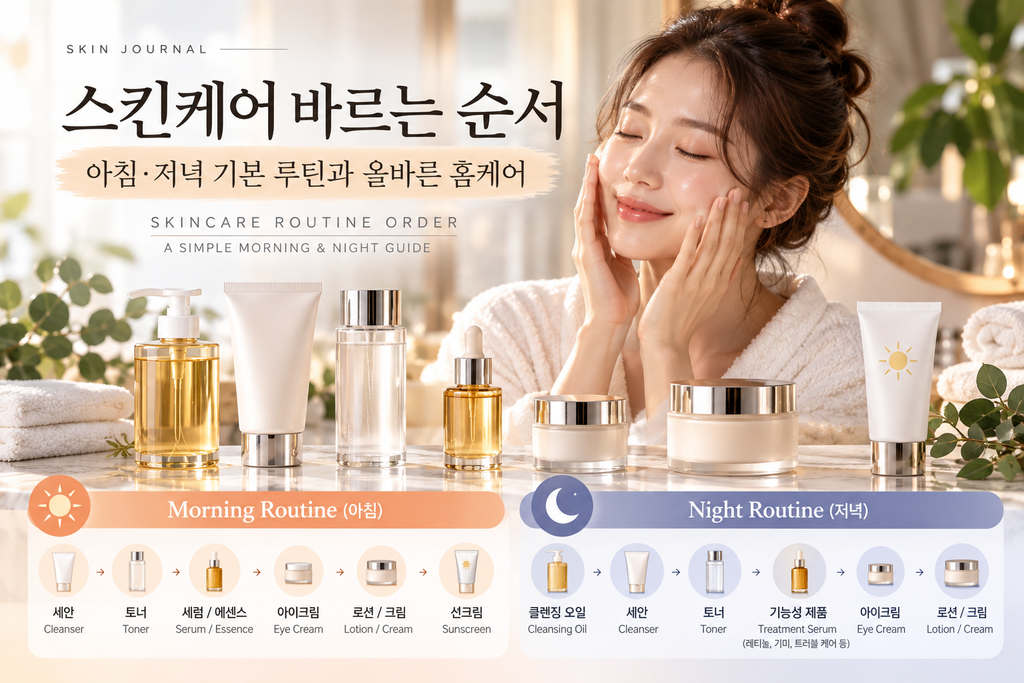
Because active skincare products can have different directions, always follow the instructions provided with the product. For prescription products, follow the guidance of your healthcare professional.
Why I Personally Consider Toner an Important Step
Toner is not considered an essential step for everyone, but personally, I consider toner an important part of my home skincare routine.
For me, toner is not simply something used to wipe the skin. It is the first step after cleansing to refresh the skin and add hydration.
After cleansing, gently pat away excess water with a clean towel. If you use a toner pad, gently sweep it over the skin without rubbing aggressively.
Then apply toner evenly over the face or mist it onto the skin for hydration.
Rather than applying a large amount all at once, I sometimes layer toner:
First layer → gently absorb
Second layer → apply another light layer
For dry skin → add a third or fourth light layer if needed
The idea is to add hydration gradually according to how the skin feels rather than saturating the skin with a large amount at once.
After that, you can continue with your serum, essence, lotion, or moisturizer as needed.
However, layering toner does not replace moisturizer. After adding hydration, finish with a lotion or moisturizer appropriate for your skin.
Morning Is About Protection; Evening Is About Cleansing and Moisture
In the morning, you do not necessarily need to layer many products. A simple routine based on your skin’s needs can be enough.
Cleanse → Toner → Needed Serum → Lotion / Moisturizer → Sunscreen
If your skin is dry, you may want a little more moisture. If your skin tends to be oily, a lighter lotion or gel moisturizer may feel more comfortable than a heavy cream.
And the final step of your morning skincare routine should be sunscreen.
In the evening, before thinking about what to put on your skin, think about what needs to come off your skin first.
If you wore makeup or a water-resistant sunscreen, you may use a cleansing oil, balm, cream, or lotion cleanser first, followed by a gentle facial cleanser.
If you are wearing heavier eye or lip makeup, you can use an appropriate makeup remover on those areas first.
However, there is no need to automatically double- or triple-cleanse every night when your skin does not require it.
Cleansing thoroughly and cleansing aggressively are not the same thing.
Washing for too long, rubbing excessively, or repeatedly cleansing the skin may leave it feeling dry or sensitive.
There Is No One Perfect Exfoliation Schedule
Exfoliation does not need to follow the same schedule for everyone.
For younger or oilier skin that tends to develop buildup or clogged pores, gentle exfoliation once or twice a week may be appropriate depending on the skin and the products being used.
As we age, the skin’s natural renewal and recovery processes can slow, while dryness and sensitivity may also increase.
That does not mean older skin should automatically be exfoliated more often, nor does younger skin always need frequent exfoliation.
If your skin already feels smooth and comfortable, there is no reason to exfoliate simply because a schedule says you should.
On the other hand, if the skin feels rough, daily scrubbing or aggressive exfoliation is not the answer either.
Instead of focusing only on how many times per week you exfoliate, pay attention to whether your skin actually needs exfoliation at that moment.
I Don’t Follow a Perfect Routine Every Day Either
I am also in my 50s, and I do not follow a long, multi-step skincare routine perfectly every single day.
Sometimes it is late, I am tired, or I simply do not feel like doing many steps.
On those days, my simplest routine is cleansing, adding plenty of hydration with toner, and finishing with moisturizer.
I may lightly layer my toner several times and then simply finish with a cream.
I also do not exfoliate frequently at home. Because I receive professional skincare treatments periodically as needed, I adjust my home exfoliation according to how my skin feels and what it needs.
The important thing is not to perform every skincare step perfectly every day. It is to create a basic routine that you can realistically maintain.
It is okay to simplify your routine when you are tired.
Just try to stay consistent with the basics: cleanse, hydrate, and moisturize.
The Best Routine Is One That Works for Your Skin
Having more products on your vanity does not necessarily mean your skin will be healthier.
Dry skin and oily skin have different needs, and skin in your 20s may need something different from skin in your 50s and beyond.
Even the same person’s skin can change with the seasons, environment, lifestyle, and overall condition.
Rather than memorizing skincare order as a strict formula, I prefer to think of it as a basic flow:
Clean → Hydrate/Treat → Moisturize → Protect
Clean the skin,
add hydration and any treatments you need,
moisturize,
and protect your skin from the sun during the day.
From there, you can add or remove products and steps according to what your skin needs.
Home Care and Professional Skincare Have Different Roles
Even if we brush our teeth carefully every day, we still visit the dentist periodically for professional cleaning.
Daily brushing cannot always reach every area perfectly, and buildup can occur in places that are difficult to clean at home.
I think skincare is similar.
Even when you consistently cleanse and use toner, serum, moisturizer, and sunscreen at home, there may be areas or concerns that are more difficult to address through home care alone.
Depending on your skin, buildup on the surface, clogged pores, excess oil, dryness, or rough texture may sometimes benefit from more focused care.
Professional skincare can complement your home routine by allowing your current skin condition to be assessed and providing additional exfoliation, pore care, hydration, and soothing treatments that may be difficult to perform effectively at home.
Home skincare is your everyday foundation, while professional skincare can provide more focused care when your skin needs additional attention.
Skincare is not about doing something intensive once in a while. The small habits you repeat every day matter.
Just as eating and brushing your teeth become natural parts of everyday life, I hope morning and evening skincare can become a comfortable routine that fits naturally into your day.
Consistency is more important than a perfect skincare routine.
And when needed, professional skincare can complement what you do at home.
I believe this balance can help support healthy-looking skin over time.
Skin condition and individual responses can vary. This article is intended for general skincare information only. The appropriate routine may differ depending on the ingredients and directions of the products you use and your individual skin condition. If you are using prescription or medicated skincare products, follow the product instructions or guidance provided by a qualified healthcare professional. If you experience persistent redness, itching, pain, or other ongoing skin concerns, consider consulting a healthcare professional.